
Quick Answer
For many enclosed waste recycling and shredding lines, we usually recommend a cartridge dust collector with source capture because it is compact, suitable for many fine dry dust sources, and can support pulse cleaning near shredders, sorters, screens, and conveyor transfer points.
If the process creates coarse pieces, heavy dust load, or mixed light material, a cyclone dust collector can be used as a pre-separator before final filtration. For larger material recovery facilities or central multi-point systems, a baghouse dust collector may be more suitable.
If the waste stream is wet, odorous, hot, contaminated, or potentially combustible, we would first check the feed material, process temperature, moisture, dust behavior, airflow, and site safety requirements before recommending the final system.
Dust Sources in Waste Recycling and Shredding
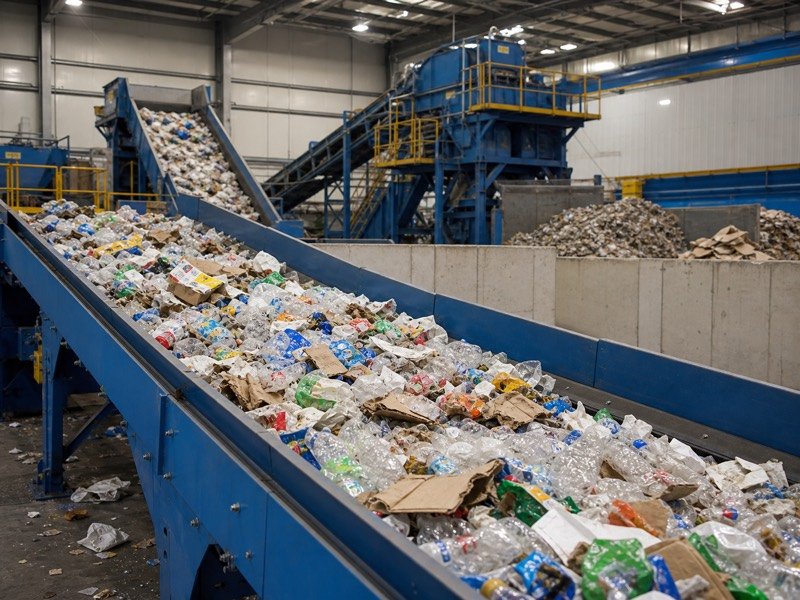
Waste recycling dust is usually generated when mixed material is dropped, cut, shredded, crushed, screened, sorted, or conveyed. Common dust points include tipping areas, manual sorting tables, shredder inlets, shredder discharge points, crushers, trommel screens, vibrating screens, air classifiers, conveyor transfers, bunkers, balers, and bagging or discharge points.
The material stream may include paper, cardboard, plastics, textiles, rubber, wood, glass fines, dirt, coatings, labels, and small residues from incoming waste. In RDF or SRF preparation, the dust may be lighter and more fibrous. In e-waste or scrap-related streams, dust composition can change quickly from batch to batch.
Because feed material varies, the dust collection system should not be selected only by the shredder size. The capture method should follow where dust escapes and how the material moves through the line.
Dust Characteristics and Collection Challenges
Waste recycling dust is often mixed. It may contain fine powder, paper fiber, plastic fines, fluff, grit, mineral particles, labels, coating dust, and occasional larger chips. Light particles can stay airborne longer than heavy dust, while fibrous material can cling to equipment and filters.
The main challenge is variability. One shift may process dry cardboard and plastic packaging, while another shift may include dirty mixed waste, rubber, textiles, or wet material. Dust load, moisture, particle shape, and filter behavior can all change.
For this reason, pre-separation and duct design matter. Coarse particles and light debris should be controlled before they overload filters. Duct velocity should be high enough to keep material moving, while hoods and enclosures should avoid pulling in large recyclable material that should stay on the process line.
Recommended Dust Collector for Waste Recycling and Shredding
For local shredders, sort lines, screen outlets, and conveyor transfers, a cartridge collector is often a practical option when the dust is mostly dry and the airflow is moderate. It offers a compact footprint and is suitable for many enclosed or semi-enclosed capture points.
For heavy loading, coarse particles, or mixed light debris, a cyclone can be useful before the final collector. The cyclone can reduce the amount of larger material reaching the filters, but it is usually not enough as the final filtration stage for fine dust.
For larger recycling plants with several dust points running at the same time, a central baghouse may be more suitable. Baghouse systems can handle larger airflow and heavier dust loading. For early equipment comparison, the existing baghouse vs cartridge dust collector guide can support the first selection discussion.
How the Dust Collection System Works
A waste recycling dust collection system starts with capture near the dust source. The capture point may be a hood above a conveyor transfer, a partial enclosure at the shredder discharge, a duct connection near a screen, a pickup point at an air classifier, or an enclosure around a dusty sorting section.
Captured air moves through ductwork to the collector. In many recycling lines, the system may first pass through a cyclone or drop-out section to remove heavier particles and reduce filter loading. Fine dust is then filtered by a cartridge collector or baghouse before the air is discharged according to the project layout.
For multi-point systems, branch ducts and balancing dampers help distribute airflow between machines. Maintenance access is important because recycling dust can collect around hoods, duct elbows, hoppers, and discharge bins.
Key Selection Factors
Before selecting a waste recycling dust collector, review the process and material stream first.
| Factor | What to check |
|---|---|
| Process | Sorting, shredding, crushing, screening, air classification, conveying, baling, or discharge. |
| Material stream | Paper, cardboard, plastic, textile, rubber, wood, e-waste, RDF/SRF, or mixed municipal waste. |
| Dust behavior | Fine, fibrous, fluffy, abrasive, sticky, moist, hot, or mixed with coarse particles. |
| Dust points | Number of capture points and how many run at the same time. |
| Airflow | Hood opening, enclosure size, duct length, branch quantity, and pressure loss. |
| Discharge | Dust bin, rotary valve, sealed drum, recovered material, or waste disposal. |
| Safety review | Combustible dust potential, sparks, static, hot particles, moisture, and site rules. |
If airflow is unclear, start with a line layout, machine photos, opening sizes, material type, and the number of operating points. The guide on how to calculate airflow for a dust collection system can help with early planning.
Recommended System Configuration
A small enclosed recycling cell may use a local hood or enclosure, short duct, compact cartridge collector, fan, control panel, and dust bin. This works best for dry material, limited dust points, and moderate airflow.
A medium shredding line may use multiple capture hoods, branch ducts, a cyclone pre-separator, a cartridge collector, fan, controls, and dust discharge equipment. This layout is useful when the process creates both coarse pieces and fine airborne dust.
A larger material recovery facility may need a central system with several duct branches, a cyclone or drop-out section, baghouse filtration, a larger fan, controls, and planned maintenance access. The final configuration depends on material type, dust load, airflow, installation space, operating schedule, and whether the process runs continuously.
Safety and Special Design Considerations
Waste recycling and shredding dust should be reviewed carefully because the incoming material can change. Some streams may include combustible dust, static-sensitive plastic fines, paper fibers, rubber dust, hot particles, sharp fragments, or unknown contaminants.
If combustible dust, sparks, or hot particles are possible, explosion protection, spark control, isolation, grounding, housekeeping, and local safety requirements should be reviewed by qualified parties before installation. Novazure should not treat one standard collector as suitable for every waste recycling line.
Dry dust collectors are mainly for particulate control. Odor, vapor, wet washing exhaust, chemical fumes, and biological contaminants may need separate review. If the line handles wet or odorous material, we would first confirm whether dry dust collection alone is appropriate.
Why Choose Novazure for Waste Recycling Dust Collection
Novazure provides practical industrial dust collector systems for recycling and shredding applications, including cartridge collectors, cyclone pre-separation, baghouse collectors, fans, ductwork, controls, and related system components.
For waste recycling projects, we help review the material stream, dust sources, capture method, airflow, duct route, collector type, dust discharge, installation space, and maintenance access. Instead of only quoting a collector model, the system should match the actual recycling line and material flow.
If your project is mainly plastic bottle or plastic flake recycling, a plastic-specific recycling dust collection page may be a closer fit after that page is published. If your project includes bulk transfer or silo venting, our bulk powder and material handling dust collection page may also be useful. For more scenarios, visit the dust collection applications hub.
FAQ
For many dry enclosed recycling lines, a cartridge dust collector is suitable for local or medium-airflow dust points. For heavy dust load, multiple capture points, or continuous central systems, a baghouse collector may be more suitable. A cyclone can help as a pre-separator.
Usually not as the final filter. A cyclone can remove coarse particles and reduce filter loading, but fine recycling dust normally needs cartridge or baghouse filtration after pre-separation.
Not always. Paper, plastic, rubber, textiles, e-waste, RDF, and mixed waste can behave differently. The collector should be selected after checking the material stream, dust load, moisture, spark risk, and capture points.
Send the recycling process flow, material types, machine photos, number of dust points, operating schedule, known airflow if available, dust condition, temperature, moisture, installation space, and layout drawing.
Request a Waste Recycling Dust Collection Solution
If you need a dust collection system for waste sorting, shredding, crushing, screening, conveying, baling, or RDF/SRF preparation, send us your material information, process layout, dust source photos, airflow requirement, and working points.
Novazure will help you review whether a cartridge dust collector, cyclone pre-separator, baghouse collector, or central waste recycling dust collection system is more suitable for your line.