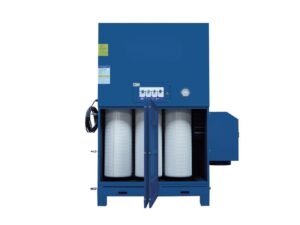
Welding fume extraction airflow should be estimated from the capture method first, not only from the workshop size or the dust collector name. For a welding project, the main questions are: where is the fume generated, how close can the suction point stay to the weld, how many stations run at the same time, and how much duct resistance will the system create?
If you need the general airflow formulas, the published guide on how to calculate airflow for a dust collection system explains hood opening calculation, duct airflow, multiple collection points, and why air changes per hour should not replace source capture. This article uses those principles for one specific application: welding fume extraction.
For broader equipment selection, see the main welding fume extraction system page. This guide focuses only on the airflow planning side before quotation.
Quick Answer: What Determines Welding Fume Extraction Airflow?
The required airflow depends on the capture point, not only the welding machine. A suction arm close to the weld may need a different airflow from a large hood, a downdraft table, or a central ducted system serving several fixed welding stations.
| Factor | Why It Matters |
|---|---|
| Capture method | Suction arm, hood, booth, enclosure, and downdraft table each require different airflow planning. |
| Capture distance | Welding fumes rise quickly; a capture point farther from the source usually needs more review. |
| Station count | More welding points usually increase total airflow demand. |
| Simultaneous operation | The system should be sized around how many stations run at the same time, not only how many are installed. |
| Duct layout | Long ducts, elbows, branches, and dampers affect pressure loss and fan selection. |
| Welding process and material | Fume amount, heat, sparks, and material condition can affect capture design and filter loading. |
| Mixed dust condition | Welding combined with grinding or cutting may change the collector and pre-separation review. |
In simple terms, calculate or estimate airflow at each capture point first. Then review how many points operate together. Finally, check duct resistance, filter area, fan pressure, and the final dust collector configuration.
Why Welding Fume Airflow Is Different From General Dust Collection
Welding fumes are fine, hot, and easy to move with rising thermal airflow. They do not behave like heavy dust that falls quickly near the source. If the suction arm, hood, or booth opening is too far from the weld, fumes may pass through the operator area or spread into the workshop before the system can capture them.
This is why welding airflow calculation should not start with only a room-volume number. General ventilation may help background air movement, but welding fume extraction usually needs source capture near the weld point.
For a practical airflow estimate, start with these questions:
- Is the capture point a flexible suction arm, fixed hood, enclosure, downdraft table, or duct branch?
- Is the welding point fixed or changing?
- How close can the capture point stay to the fume source during real operation?
- How many welding stations are active at the same time?
- Is the system portable, local, or central ducted?
- Are grinding dust, cutting sparks, or other particles mixed with the welding fume?
The answer to these questions decides whether the airflow can be estimated simply or whether the layout needs engineering review before quotation.
Step 1: Define the Capture Method
The capture method is the starting point for welding fume extraction airflow. The same workshop may need different airflow if the fume is captured by a suction arm instead of a booth or a fixed hood.
| Capture Method | Common Welding Use | Airflow Planning Notes |
|---|---|---|
| Flexible suction arm | Manual welding station | Confirm arm diameter, hood style, reach, and practical distance from the weld. |
| Fixed hood | Repeated welding position | Estimate from hood opening area and selected face velocity, then review capture distance. |
| Enclosed booth or cell | Repeated welding, robotic welding, or fixed process | Check opening size, enclosure leakage, working access, and exhaust connection. |
| Downdraft table | Small parts welding or light mixed work | Review table size, open area, workpiece blockage, and whether grinding dust is also present. |
| Central duct branch | Multiple fixed stations | Estimate each branch first, then check simultaneous use and duct balance. |
For early quotation, you do not need a final engineering drawing. But you should know which capture method is planned because that choice controls the airflow estimate.
Step 2: Estimate Airflow Per Welding Station
After the capture method is clear, estimate the airflow required for each welding station or capture point.
For a fixed hood, booth opening, or enclosure opening, the basic idea is:
Airflow = opening area x selected capture or face velocity
In metric units, the common formula is:
Airflow (m3/h) = opening area (m2) x velocity (m/s) x 3600
This is the same base formula used in general dust collection airflow calculation. The welding-specific question is not the formula itself. The important question is which opening, capture distance, and practical welding condition should be used.
For example:
- A small hood close to a fixed weld point is different from a large open hood above a table.
- A suction arm that operators reposition often is different from a fixed hood.
- A welding booth with a defined opening is different from an open workshop area.
- A central system serving several stations must consider branch balance and simultaneous operation.
If the exact hood opening, suction arm size, or capture velocity is not confirmed, mark the airflow as a preliminary estimate. Novazure can then review the station photos, hood size, and layout before recommending the final collector and fan configuration.
Step 3: Review Suction Arm Position for Portable Welding Fume Extractors
For a single welding station or flexible work area, a portable dust collector may be used with a flexible suction arm. In this case, airflow depends strongly on how the arm is positioned.
Before estimating airflow, check:
- suction arm diameter
- hood shape at the arm end
- distance from the hood to the weld point
- whether the arm can stay close during real welding
- whether the operator needs to move around large workpieces
- working hours and fume load
A portable extractor should not be selected only because the station is small. If the suction arm is usually too far from the weld, fumes may escape before they enter the hood. If the welding time is long or the fume load is high, filter area and maintenance frequency should also be reviewed.
For quotation, send photos of the welding table, expected arm position, workpiece size, and available space around the station. This helps the supplier decide whether a portable unit is practical or whether a fixed hood or central system should be considered.
Step 4: Estimate Total Airflow for Multiple Welding Stations
For a central ducted welding fume extraction system, calculate each capture point first, then estimate the total airflow.
The simple planning logic is:
Total airflow = airflow per active station x number of active stations
If different stations use different capture methods, estimate each station separately and then add the active points together.
| Layout Condition | Airflow Planning Approach |
|---|---|
| All stations operate together | Add airflow for all connected active stations. |
| Only some stations operate at once | Confirm simultaneous operation before sizing the fan and collector. |
| Some stations are future expansion | Keep future branches in the layout plan, but do not blindly oversize the whole system. |
| Stations use different hoods or arms | Estimate each branch separately instead of using one average number. |
| Robotic or repeated cells | Review enclosure opening, cycle pattern, and capture connection. |
This step is where many welding projects become more specific than a general airflow article. A central welding fume system is not just several portable units connected together. It needs branch duct design, airflow balance, fan pressure review, and maintenance access.
Step 5: Check Duct Layout Before Choosing the Fan
After airflow is estimated, the duct layout must be checked. A fan is not selected only by airflow volume. It must also overcome system resistance.
For a welding fume extraction system, duct review should include:
- main duct length
- branch duct length
- duct diameter
- number of elbows
- branch connection points
- dampers or balancing devices
- collector inlet position
- fan position
- spark or hot particle review before filtration
Long duct distance and many elbows can increase pressure loss. Poor branch layout can make some stations weak while others pull too much air. If the welding fume system connects several stations, a simple layout sketch is often more useful than a rough airflow number alone.
The general airflow article explains duct airflow and velocity checking. For welding, the additional point is station balance: each welding capture point must still have enough suction after the central duct layout is built.
Step 6: Match Airflow With Filter Area and Collector Type
The airflow estimate also affects the dust collector selection. For many fine dry welding fume applications, a cartridge dust collector is commonly used because cartridge filters provide a large filtration area in a compact structure.
However, airflow is only one part of the selection. Filter area, fume load, working hours, cleaning method, and maintenance access also matter.
| Item | Why It Matters |
|---|---|
| Airflow volume | Affects collector size, fan selection, duct diameter, and filter load. |
| Filter area | Helps control pressure drop and cleaning frequency. |
| Working hours | Continuous welding needs more stable filtration planning than occasional work. |
| Fume concentration | Higher fume load may require larger filter area or more careful maintenance planning. |
| Mixed dust | Grinding or cutting dust may require different review before entering the collector. |
| Spark condition | Sparks or hot particles should be reviewed before the air reaches the filter area. |
Do not choose a dust collector only by matching a published airflow rating. A collector that can move a certain airflow still needs the right capture method, duct pressure, filter area, and working condition review.
Common Mistakes in Welding Fume Airflow Estimation
Avoid these common mistakes before requesting a quotation:
| Mistake | Why It Causes Problems |
|---|---|
| Sizing only by workshop area | General room volume does not confirm source capture at the weld point. |
| Ignoring suction arm distance | A hood too far from the weld may not capture fumes effectively. |
| Adding all installed stations without checking simultaneous use | The system may become oversized and more expensive than needed. |
| Using one airflow value for every station | Different hoods, booths, arms, and workpieces may need different estimates. |
| Ignoring duct layout | Long ducts and many elbows can reduce actual suction at the station. |
| Choosing collector airflow without checking filter area | Air volume alone does not confirm stable filtration or maintenance performance. |
| Mixing grinding dust and welding fume without review | Mixed dust may change spark, dust load, and filter maintenance requirements. |
The goal is not to make the biggest possible system. The goal is to capture welding fumes close to the source with practical airflow, reasonable duct design, and suitable filtration.
What Information Should You Prepare for Novazure?
For a useful welding fume extraction airflow estimate, prepare the following information:
| Information Needed | Why It Matters |
|---|---|
| Welding process | MIG, TIG, stick, robotic welding, or other processes can create different fume conditions. |
| Base material | Carbon steel, stainless steel, galvanized steel, and coated materials may need different review. |
| Number of welding stations | Determines single-point, portable, or central system direction. |
| Active stations at one time | Helps estimate total airflow without blindly oversizing. |
| Capture method | Suction arm, hood, booth, downdraft table, or enclosure changes the airflow method. |
| Hood or opening size | Needed for preliminary airflow calculation when fixed openings are used. |
| Duct distance and route | Affects pressure loss and fan selection. |
| Workshop layout | Helps review station positions, collector location, and duct balance. |
| Working hours | Affects filter area, cleaning system, and maintenance planning. |
| Spark or mixed dust condition | Welding mixed with grinding, cutting, or heavy dust needs extra review. |
If you do not know the exact airflow yet, send the welding station photos, capture idea, station count, and layout. That is enough for a preliminary review.
Conclusion
Welding fume extraction airflow should be calculated from the capture method and station layout first. Start with each welding point, confirm the suction arm, hood, booth, or enclosure, then estimate the active stations and duct route.
The general airflow formula is useful, but welding projects need extra attention to fume plume movement, hood distance, operator movement, simultaneous station use, branch duct balance, and filter maintenance. A practical estimate should help choose the dust collector and fan, not just produce a number.
Before requesting a quotation, prepare your welding process, base material, station count, active station count, capture method, hood size, airflow estimate, workshop layout, duct distance, and spark or mixed dust condition.
You can contact Novazure with this information. Novazure can help review whether a portable extractor, a central ducted cartridge collector, or another welding dust collector configuration is more suitable for your workshop.