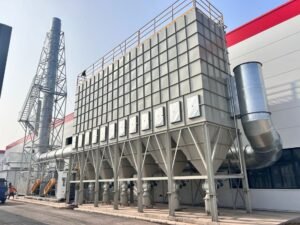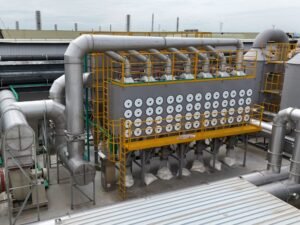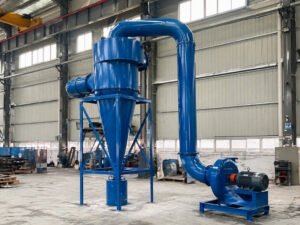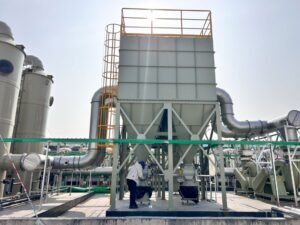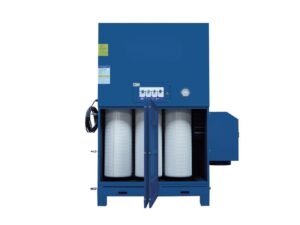
A cartridge dust collector is often the right choice for welding fume when the fume is fine and dry, the capture points are defined, airflow can be estimated, and the project needs compact filtration for one or more welding stations.
It is not the right answer for every welding-related process. Welding mixed with heavy grinding dust, cutting sparks, oily smoke, sticky particulate, high temperature, or unknown coated materials should be reviewed before selecting the collector.
If you are still defining the overall welding extraction project, start with the main welding fume extraction system page. This article focuses on one conversion-stage question: when should a welding workshop choose a cartridge dust collector?
Quick Answer: When Is a Cartridge Dust Collector Suitable for Welding Fume?
For many industrial welding fume projects, a cartridge collector is suitable when the project meets these conditions:
| Condition | Why It Supports Cartridge Collector Selection |
|---|---|
| Fine, dry welding fume | Cartridge filters provide large filtration area in a compact collector body. |
| Practical source capture | Suction arms, hoods, booths, or local capture points help collect fumes before they spread. |
| Defined airflow requirement | Airflow affects collector size, fan selection, duct diameter, and filter area. |
| Small to medium footprint requirement | Cartridge collectors are often useful where installation space is limited. |
| Multiple fixed welding stations | A central cartridge collector can serve several planned capture points. |
| Maintenance access is available | Filter replacement, dust collection, and pulse cleaning access can be planned. |
| Spark or mixed dust condition is reviewed | Welding sparks, grinding dust, and cutting particles may require additional review before filtration. |
In simple terms, choose a cartridge dust collector when the welding fume is fine and dry, the capture method is practical, and the layout can support stable airflow and maintenance.
Why Cartridge Collectors Are Common in Welding Fume Extraction
Welding fume is usually fine airborne particulate. For many dry welding and metal fabrication processes, cartridge filtration is a practical starting point because the pleated filter cartridges provide a large filtration area in a compact structure.
This makes cartridge collectors useful for:
- manual welding stations
- fixed welding booths or tables
- repeated welding fixtures
- central welding fume extraction systems
- fine dry metal fume applications
- compact indoor dust collection layouts
The collector still needs the right system design. A cartridge collector cannot solve poor source capture, weak airflow, unbalanced ductwork, or unsuitable process conditions by itself.
The Best-Fit Welding Conditions
Fine and Dry Welding Fume
Cartridge collectors are usually strongest when the dust or fume is fine and dry. This fits many welding fume applications, especially when fumes are captured close to the welding point and sent to the collector through a planned duct or local connection.
If the process includes sticky residue, oil mist, moisture, heavy slag, or unknown coatings, the project needs review before assuming a standard cartridge setup.
Defined Capture Points
A cartridge collector works best when the system has clear capture points, such as:
- flexible extraction arms
- fixed hoods
- booth exhaust points
- enclosure connections
- central duct branches from welding stations
The capture method should be decided before the collector is sized. If fumes escape before they enter the suction point, increasing collector size alone may not fix the problem.
Multiple Fixed Welding Stations
For several fixed welding stations, a central ducted cartridge system can be practical. The collector, fan, filters, and dust handling are centralized, while each station connects through a planned capture point and duct branch.
This layout is often more suitable than many separate local units when:
- station positions are stable
- the buyer wants centralized maintenance
- the duct route is practical
- simultaneous operating stations can be estimated
- filter area and fan pressure can be reviewed together
Limited Installation Space
Compared with many larger fabric-filter systems, cartridge collectors can provide a large filtration area in a more compact structure. This can be useful in welding workshops where equipment space, maintenance access, and duct routing must be planned carefully.
Compact does not mean the collector can be squeezed anywhere. Filter replacement space, dust drawer or hopper access, fan position, and control cabinet placement still need review.
When a Cartridge Dust Collector Needs Extra Review
There are welding-related conditions where a cartridge collector may still be possible, but the project should not be treated as a simple standard selection.
| Condition | Why Extra Review Is Needed |
|---|---|
| Welding mixed with heavy grinding | Dust load and particle size may increase filter loading. |
| Cutting sparks or hot particles | Sparks should be reviewed before air reaches the filter area. |
| Galvanized, coated, or painted material | Fume characteristics may change and need process review. |
| Oily or sticky particulate | Standard dry cartridge filtration may not be suitable. |
| Very high dust concentration | Filter area, cleaning method, and collector type need review. |
| Long duct distance | Fan pressure and branch balance may affect station suction. |
| Unknown working hours | Filter loading and maintenance frequency cannot be estimated well. |
This does not mean cartridge collectors should be rejected. It means the supplier needs more information before recommending filter media, filter area, spark review, fan pressure, or another collector configuration.
When a Cartridge Collector May Not Be the First Choice
A cartridge dust collector is not always the best first option if the process is outside normal fine dry welding fume conditions.
Request additional engineering review when:
- the process includes heavy grinding dust as the main load
- the dust is wet, oily, sticky, or adhesive
- the air stream is hot enough to require temperature-specific review
- sparks or hot particles are frequent and difficult to control
- airflow is very large and continuous
- dust concentration is much higher than typical welding fume
- the source cannot be captured close to the welding point
In some projects, capture design, pre-separation, spark review, filter media selection, or another collector type may need to be considered. The right decision depends on the real welding process, not only the word “welding.”
Cartridge Dust Collector vs Portable Welding Fume Extractor
For one flexible welding station, a portable dust collector may be enough. It is easier to position locally and may not require central ductwork.
A central cartridge collector is usually more suitable when several fixed welding points need planned extraction through one system.
| Selection Question | Portable Dust Collector | Cartridge Dust Collector / Central System |
|---|---|---|
| Number of stations | One station or small flexible area | Multiple fixed stations or central extraction |
| Welding point movement | Changes often | Mostly fixed or planned |
| Ductwork | Little or no fixed ductwork | Planned branch and main ducts |
| Maintenance | Local unit maintenance | Centralized collector maintenance |
| Expansion | Limited by local unit placement | Can be planned with future branches if reviewed |
| Best use | Flexible local capture | Stable production layout with defined capture points |
The two options are not enemies. Many welding workshops need to decide whether the project is local and flexible, or fixed and centralized.
Airflow and Filter Area Still Decide the Final Size
Do not choose a cartridge collector only by the product name. The collector size depends on airflow, filter area, dust load, working hours, duct resistance, and cleaning method.
Key questions include:
- How many welding stations are connected?
- How many stations operate at the same time?
- What capture method is used at each point?
- What airflow is required at each capture point?
- How long is the duct route?
- How many elbows and branches are included?
- What working hours and fume load should the filters handle?
For general airflow principles, the published guide on how to calculate airflow for a dust collection system explains hood area, duct airflow, and multiple collection points. For welding fume, Novazure should still review the capture method, duct layout, and filter loading before final equipment selection.
Typical Cartridge System Configuration for Welding Fume
A welding fume cartridge collector project may include:
- cartridge collector body
- pleated filter cartridges
- pulse jet cleaning system
- fan and control cabinet
- suction arm, hood, booth connection, or enclosure connection
- ductwork for central systems
- dust drawer, bin, or hopper
- spark or mixed dust review before filtration
- maintenance access for filters and dust discharge
The exact configuration depends on station count, capture method, airflow, duct route, working hours, and dust condition. A small manual welding station and a multi-station fabrication line should not be quoted from the same rough equipment list.
Buyer Checklist: Is Cartridge Filtration a Good Fit?
Use this checklist before asking for a quotation.
| Question | If Yes | If No / Unknown |
|---|---|---|
| Is the welding fume mainly fine and dry? | Cartridge collector is likely worth reviewing. | Confirm material, coating, moisture, oil, or mixed dust first. |
| Are capture points defined? | Airflow and collector sizing can be reviewed. | Decide arms, hoods, booths, or other capture methods first. |
| Are there multiple fixed stations? | Central cartridge system may be practical. | Review portable or local extraction instead. |
| Is the airflow estimate available? | Collector and fan selection can move faster. | Prepare hood size, station count, and layout information. |
| Is duct distance known? | Pressure loss can be reviewed. | Send a workshop sketch or layout. |
| Are sparks or grinding dust present? | Include spark and mixed dust review. | Confirm process details before final selection. |
| Is maintenance space available? | Filter replacement and dust discharge can be planned. | Collector position may need adjustment. |
This checklist is not a final engineering calculation. It helps determine whether a cartridge dust collector is the right product path for the quotation.
What Information Should You Send for a Quotation?
For a useful welding fume cartridge collector quotation, prepare:
- welding process
- base material and coating condition
- number of welding stations
- number of stations operating at the same time
- capture method, such as arm, hood, booth, or enclosure
- airflow estimate, if available
- duct distance and layout sketch
- working hours per day
- whether grinding, cutting, sparks, or hot particles are present
- available installation space
- photos or videos of the welding station
If some information is not confirmed, mark it as Need confirmation. Novazure can review the project from the available details and then request the missing information.
Conclusion
A cartridge dust collector is often the right choice for welding fume when the fume is fine and dry, capture points are practical, airflow can be estimated, and the workshop needs compact filtration or a central system for multiple welding stations.
It is not a shortcut around system design. Source capture, airflow, duct layout, filter area, working hours, maintenance access, and spark or mixed dust conditions still decide the final configuration.
You can contact Novazure with your welding process, station count, capture method, airflow estimate, layout, duct distance, and spark or mixed dust condition. Novazure can help review whether a cartridge dust collector, portable collector, or another welding fume extraction configuration is more suitable for your workshop.