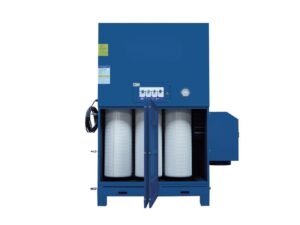
Pharmaceutical powder dust is generated during powder transfer, weighing, mixing, blending, granulation, tablet pressing, capsule filling, milling, sieving, coating, and packaging processes.
Compared with many general industrial dust applications, pharmaceutical powder dust often requires closer attention to particle size, powder behavior, filter cleaning, dust discharge, containment, and possible combustible dust risk.
A dust collector should not be selected only by airflow. In pharmaceutical manufacturing, the powder type, dust source, operating schedule, capture method, filter media, cleaning performance, and safety requirements all affect the final equipment selection.
This guide explains the key challenges in pharmaceutical powder dust collection and the practical design factors buyers should check before requesting a dust collector quotation.
Quick Answer
Pharmaceutical powder dust collection depends on the dust source, powder behavior, airflow, and safety requirements.
| Powder or process condition | Design consideration |
|---|---|
| Fine dry powder | Cartridge dust collector is often considered first |
| High dust load | Baghouse dust collector may be more suitable |
| Sticky or hygroscopic powder | Filter media and cleaning method need careful review |
| Tablet press or capsule filling | Local cartridge or portable dust collection may be used |
| Multiple dust points | Central cartridge or baghouse system may be considered |
| Coarse particles mixed with fine powder | Cyclone pre-separation may help reduce filter load |
| Combustible powder | Explosion protection should be evaluated |
| Exposure or containment concern | Secondary filtration or sealed dust handling may be required |
For a complete industry-level overview, see our pharmaceutical dust collection system application page.
Where Pharmaceutical Powder Dust Is Generated
Pharmaceutical powder dust usually appears when powder is moved, dropped, filled, compressed, or disturbed by air movement.
Common dust-generating points include:
- Raw material weighing
- Manual powder dumping
- Powder transfer
- Mixer and blender feeding
- Granulation process
- Fluid bed drying discharge
- Milling and sieving
- Tablet press operation
- Capsule filling machines
- Coating process
- Packaging and filling lines
- Cleaning and maintenance points
The dust source matters because different process points need different capture methods.
For example, a tablet press may need local extraction close to the compression area. A powder transfer line may need extraction at feeding and discharge points. A production line with several machines may require a larger centralized dust collection system.
Do not select the dust collector only by the pharmaceutical product name. The same powder may need different dust collection arrangements at weighing, mixing, tablet pressing, and packaging points.
Why Pharmaceutical Powder Dust Is Difficult to Collect
Pharmaceutical powder dust can be more sensitive than ordinary dry dust. The challenge is not only collecting visible dust, but also controlling fine particles, filter blockage, dust discharge, and safety risks.
Fine and Lightweight Powder
Many pharmaceutical powders are fine and lightweight. Once released, they can stay airborne and spread quickly around the process area.
This affects system design in several ways:
- The capture point should be close to the dust source.
- The hood or machine connection should be properly positioned.
- The filter media should be suitable for fine particles.
- Collector sealing should be good enough to avoid dust bypass.
- Airflow should be matched to the actual dust release point.
Practical judgment:
If the powder becomes airborne easily, increasing the collector size is not always the first solution. The capture position and enclosure design should be checked first.
Sticky or Hygroscopic Powder
Some pharmaceutical powders absorb moisture or stick to filter surfaces. This can make dust collection more difficult.
Possible issues include:
- Dust buildup on filter cartridges or bags
- Rising differential pressure
- Poor pulse cleaning performance
- Powder bridging inside the hopper
- Dust sticking to internal surfaces
- More frequent cleaning or filter replacement
Cartridge filters are compact and efficient for fine dry powder, but sticky powder can build up between pleats. Baghouse collectors may handle some heavier dust loads better, but filter bag material and hopper discharge still need to be reviewed.
If the powder is sticky or hygroscopic, do not choose the collector only by airflow. Filter media, cleaning method, hopper angle, and discharge design are important.
Combustible Powder Risk
Some pharmaceutical powders, excipients, and fine organic powders may be combustible under certain conditions.
If combustible dust is possible, the system should be reviewed for:
- Dust explosibility data, if available
- Anti-static filter media
- Grounding
- Explosion venting
- Explosion-proof electrical components
- Isolation or suppression measures where required
- Collector location and discharge arrangement
Not every pharmaceutical powder is combustible, but the risk should not be ignored.
If the buyer does not know whether the powder is combustible, this should be confirmed before final design. It is safer to review the dust properties early than to modify the system later.
Cross-Contamination Concerns
Pharmaceutical manufacturing may involve different products, batches, or powder materials. In some cases, dust residue inside the collector or duct system may become a concern.
Design considerations may include:
- Easy cleaning access
- Smooth internal surfaces where needed
- Suitable dust discharge method
- Reduced dust accumulation points
- Proper filter replacement access
- Separate collection for different processes, if required
This does not mean every project needs a highly specialized containment system. The required level depends on the powder, production process, and plant requirements.
Containment and Exposure Concerns
Some pharmaceutical powders may require stricter control due to exposure limits, active ingredients, or internal production standards.
In these cases, buyers may need to consider:
- Better source enclosure
- Sealed dust collection container
- Secondary filtration
- Safer filter replacement method
- Better maintenance access
- Higher filtration assurance
If the powder has exposure concerns, the dust collector should be discussed as part of the process control system, not just as a simple exhaust device.
Dust Collector Selection for Pharmaceutical Powder
The right dust collector depends on the process, powder behavior, airflow, dust load, and safety requirements.
Novazure mainly recommends cartridge dust collectors and baghouse dust collectors for pharmaceutical powder dust collection. Cyclone and portable dust collectors may be used in specific situations.
Cartridge Dust Collector for Pharmaceutical Powder
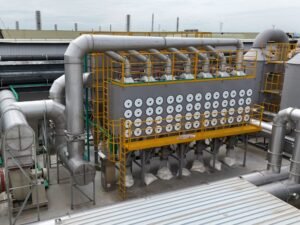
A cartridge dust collector is often suitable for fine dry pharmaceutical powder and local extraction points.
It may be used for:
- Tablet press dust collection
- Capsule filling dust collection
- Powder weighing stations
- Small powder transfer points
- Local packaging dust extraction
- Compact production areas
Cartridge filters provide a large filtration area in a compact structure. This makes them suitable for many local pharmaceutical dust collection applications.
However, cartridge collectors should be selected carefully if the powder is sticky, oily, hygroscopic, or very high in concentration. Dust may build up between pleats if it does not release well during pulse cleaning.
For fine dry powder near a tablet press or capsule filling machine, a cartridge dust collector is often a practical starting point. For sticky powder or heavy dust load, filter cleaning performance should be checked carefully.
Baghouse Dust Collector for Larger Pharmaceutical Systems
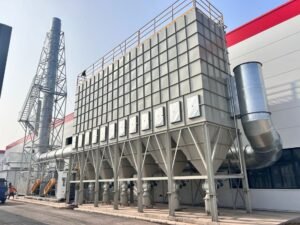
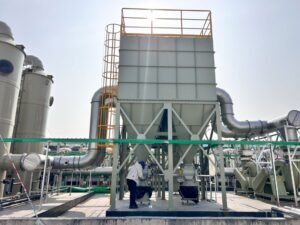
A baghouse dust collector may be more suitable when the airflow is large, the dust load is higher, or several dust points are connected to one system.
It is commonly considered for:
- Central dust collection systems
- Multiple powder handling points
- Larger airflow requirements
- Continuous operation
- Higher dust concentration
- Larger filter area requirements
- Processes that need continuous dust discharge
Baghouse collectors can provide stable filtration capacity for larger systems. They may be more suitable than small local collectors when several production points operate at the same time.
When multiple machines operate together, calculate airflow based on simultaneous operation. Do not simply add dust points without checking which points run at the same time.
Cyclone Pre-Separator
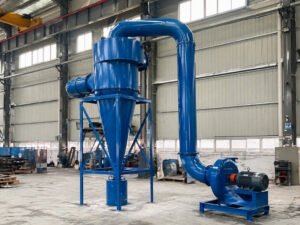
A cyclone dust collector is usually not suitable as the final filtration solution for fine pharmaceutical powder.
However, it may be used as a pre-separator when:
- Coarse particles are mixed with fine powder
- Abrasive particles may damage filters
- Heavy particles need to be reduced before final filtration
- The main filter needs protection from high dust load
For most fine powder dust collection, a cyclone should be followed by a cartridge or baghouse collector.
If the dust is mainly fine pharmaceutical powder, do not rely on a cyclone alone. It can reduce coarse particles, but final filtration is still needed.
Portable Dust Collector
A portable dust collector may be suitable for small, temporary, or flexible local dust collection needs.
It may be considered for:
- Small workstations
- Temporary powder handling
- Maintenance-related dust points
- Small test production areas
- Local extraction where a central system is not needed
Portable collectors are not the main solution for large pharmaceutical production lines. They are better used for limited dust sources or flexible work areas.
Key Design Considerations
A pharmaceutical dust collector should be selected together with the capture method, filter media, cleaning system, dust discharge, and safety requirements.
Source Capture
Dust should be captured as close as possible to the release point.
Common capture methods include:
- Local hood
- Machine connection port
- Partial enclosure
- Backdraft extraction
- Downdraft extraction
- Extraction near filling or discharge points
If the hood is too far from the dust source, powder may spread before entering the airflow.
Poor source capture cannot always be solved by using a larger dust collector. The capture point, opening size, and airflow path should be checked first.
Airflow and Capture Velocity
Airflow depends on:
- Dust source size
- Hood design
- Machine opening size
- Powder release condition
- Number of dust points
- Whether dust points operate at the same time
- Required capture effect
For pharmaceutical powder, airflow should be enough to capture dust without creating unnecessary disturbance around the process area.
Excessive airflow may disturb lightweight powder, while insufficient airflow may allow dust to escape.
Filter Media Selection
Filter media should be selected based on powder properties and operating requirements.
Possible considerations include:
- Standard filter media for dry powder
- Surface-treated media for easier dust release
- Anti-static media for combustible powder
- Moisture-resistant consideration for hygroscopic powder
- Flame-retardant media where fire risk is present
The right filter media can reduce pressure drop increase and improve pulse cleaning performance.
Pulse Cleaning Performance
Pulse cleaning helps remove dust from filter cartridges or bags. For pharmaceutical powder, cleaning performance depends on whether the powder releases easily from the filter surface.
If the powder is sticky or moisture-sensitive, dust may stay on the filter and increase differential pressure.
Buyers should consider:
- Dust release behavior
- Filter area
- Pulse cleaning pressure
- Cleaning interval
- Filter media surface treatment
- Dust concentration
Dust Discharge
Dust discharge is often overlooked, but it is important in pharmaceutical powder applications.
Possible discharge methods include:
- Dust drawer
- Dust bin
- Sealed dust collection container
- Rotary valve
- Screw conveyor for larger systems
Some powders may bridge, compact, or stick inside the hopper. If collected dust cannot discharge smoothly, the system may lose performance.
Secondary Filtration
Secondary filtration may be considered when:
- The powder is very fine
- The process has exposure concerns
- The customer has internal plant requirements
- Higher filtration assurance is needed
- The air discharge requirement is stricter
Secondary filtration should be selected based on the actual powder and plant requirement. It should not be added only as a marketing feature.
Material and Cleanability
In some pharmaceutical applications, stainless steel contact parts or smoother surfaces may be required.
This depends on:
- Powder properties
- Cleaning requirements
- Corrosion risk
- Internal plant standards
- Contact or non-contact area
- Maintenance method
Not all parts must be stainless steel in every project. The material selection should match the process and cleaning requirement.
Common Design Mistakes
1. Selecting the collector only by airflow
Airflow is necessary, but it does not tell the full story. Powder behavior, dust load, filter media, cleaning performance, and dust discharge are also important.
2. Treating all pharmaceutical powders the same
Dry excipient powder, sticky herbal powder, active ingredient dust, and coated tablet dust may need different dust collection designs.
3. Ignoring powder stickiness
Sticky or hygroscopic powder can block filters, increase pressure drop, and create hopper discharge problems.
4. Using cartridge filters without checking dust release
Cartridge filters are useful for fine dry powder, but they may not be the best choice if powder builds up between pleats.
5. Ignoring combustible dust risk
Some pharmaceutical powders may be combustible. Explosion protection should be reviewed early if there is any risk.
6. Poor source capture design
If dust is not captured at the source, a larger collector may still fail to control the powder release.
7. Weak dust discharge design
Collected powder must leave the hopper smoothly. Bridging or blockage can affect system performance.
8. No maintenance access
Filter replacement, dust bin removal, hopper cleaning, and inspection access should be considered before confirming the system layout.
What Information Buyers Should Prepare
To recommend a suitable pharmaceutical powder dust collection system, please prepare the following information.
Process Information
- Pharmaceutical process type
- Dust source
- Number of dust collection points
- Machine type or process description
- Working hours per day
- Indoor or outdoor placement
- Available space for the dust collector
- Power supply voltage and frequency
Powder Information
- Powder name or material type
- Particle size
- Dust concentration
- Bulk density, if available
- Whether the powder is dry, sticky, oily, or hygroscopic
- Whether the powder is combustible
- Whether the powder has exposure or containment concerns
- Material or exhaust temperature
- Whether coarse particles are mixed with fine powder
System Requirements
- Required airflow, if known
- Required emission standard, if any
- Whether secondary filtration is required
- Whether stainless steel material is required
- Whether explosion protection is required
- Preferred dust discharge method
- Photos, layout drawings, or process flow diagrams
If airflow is not clear, photos of the dust source, machine size, working process, and powder condition can help with initial selection.
Recommended Selection Summary
| Pharmaceutical application | Main dust issue | Usually suitable collector |
|---|---|---|
| Tablet press | Fine dry powder near machine | Cartridge dust collector |
| Capsule filling | Local dust release | Cartridge or portable dust collector |
| Powder transfer | Fine powder or medium dust load | Cartridge or baghouse dust collector |
| Mixing and blending | Dust during feeding and discharge | Cartridge or baghouse dust collector |
| Large central system | Multiple dust points and larger airflow | Baghouse dust collector |
| Coarse particle pre-separation | Mixed coarse particles | Cyclone pre-separator |
| Combustible powder | Fire or explosion risk | Safety review required |
The final selection should be based on powder properties, airflow, dust source, operating time, and safety requirements.
For an application-level overview, visit our pharmaceutical dust collection system page.
FAQs
Pharmaceutical powder dust can be fine, lightweight, sticky, hygroscopic, combustible, or sensitive to containment requirements. These characteristics affect filter media, cleaning method, capture design, and dust discharge.
A cartridge dust collector is often suitable for fine dry pharmaceutical powder from tablet pressing, capsule filling, weighing, and local powder handling points. Sticky or hygroscopic powder should be checked carefully before selection.
A baghouse dust collector is usually considered when airflow is large, dust load is high, operation is continuous, or several dust points are connected to one central system.
A cyclone can help remove coarse particles before final filtration, but it is usually not enough for fine pharmaceutical powder. A cartridge or baghouse collector is normally required for final filtration.
Some pharmaceutical powders may be combustible. Explosion protection should be reviewed based on dust properties, test data, equipment location, and local safety requirements.
Important information includes powder type, dust source, particle size, dust concentration, airflow, moisture or stickiness, combustibility, number of dust points, working hours, and filtration requirements.
Need Help with Pharmaceutical Powder Dust Collection?
Send us your powder type, dust source, airflow requirement, number of dust collection points, and process information. Novazure can help you review the application and recommend suitable dust collection equipment for pharmaceutical powder handling.