
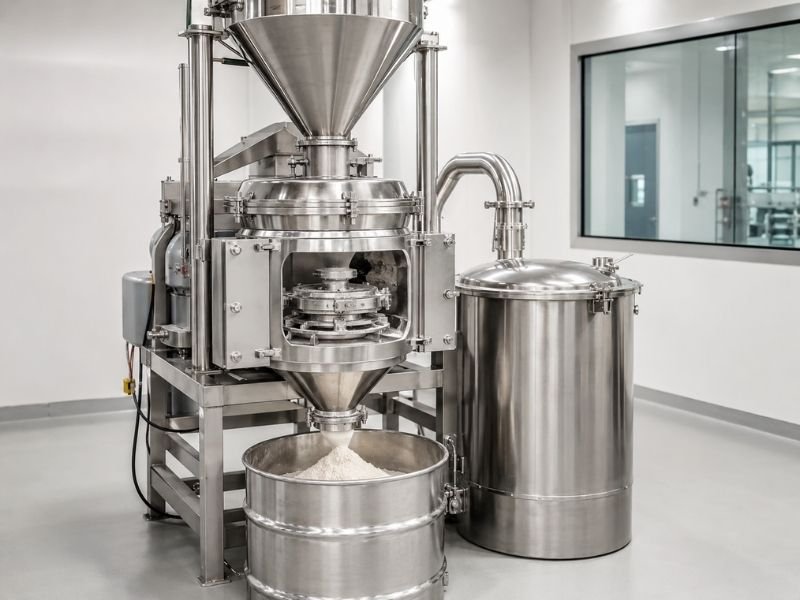
Powder Milling Dust Collection — Quick Guide
Jump directly to the part you need — dust sources, extraction strategy, collector selection, troubleshooting, or project data.
Why Powder Milling & Grinding Creates Challenging Dust
Milling and grinding do more than move powder from one place to another. The process intentionally reduces particle size, often creating a larger fraction of fine material that can become airborne during discharge, screening, transfer, and equipment opening. Dust collection therefore needs to consider both the milling equipment and how the product behaves after size reduction.
The Product Leaving the Mill May Behave Very Differently From the Feed
Coarser feed material may be relatively easy to contain, while the ground product can be finer, lighter, more cohesive, or more easily dispersed. The extraction and filtration system should therefore be designed around the condition of the powder after milling—not only the raw material entering the machine.
More Fine Particles
Size reduction increases the fraction of fine particles that can stay suspended in air or escape at openings and transfer points.
Concentrated Dust Loading
Mill discharge and product collection points can create a more concentrated dust stream than general room dust sources.
Mechanical Heat
Some milling processes generate heat through mechanical work, which can affect temperature-sensitive materials and the downstream air path.
Changed Flow Behavior
Finer powder may become more cohesive, easier to disperse, or more difficult to discharge from hoppers and collected-dust containers.
Design around the ground product, not only the mill nameplate.
Two mills with similar power can handle powders with very different particle size, bulk density, moisture, abrasiveness, stickiness, and combustible-dust properties. These differences can materially change the extraction, pre-separation, filtration, and dust-discharge arrangement.
Critical Dust Release Points Around Milling Equipment
Dust can be released before, inside, and after a mill, but the most important control points are usually where the powder path opens to the surrounding air. The discharge side deserves particular attention because the product leaving the mill may be substantially finer than the feed material.
Raw Material Feed
Bags, hoppers, feeders, screws, or pneumatic systems introduce material into the mill.
Mill / Grinder
The size-reduction chamber should remain as contained as practical during normal operation.
Product Discharge
Ground powder exits into a hopper, container, conveyor, bag, or transfer system.
Screen / Classifier
Screening or classification can re-agitate the fine product and create another release point.
Transfer / Collection
The final product is transferred to downstream processing, storage, packaging, or product collection.
Dust may escape when bags are opened, material drops into a feed hopper, or upstream conveying equipment discharges into the mill.
Dust leakage can occur around inspection doors, seals, joints, feed connections, or vent points if the machine is not properly contained or pressure-balanced.
Fine ground powder can become airborne as it falls into a receiver, bin, bag, drum, screw conveyor, or other downstream equipment.
Vibration, screening, or particle classification can release fine particles at covers, discharge chutes, and transfer interfaces.
Deposited material may become airborne when the mill, screen, duct, or collection equipment is opened for cleaning, inspection, or product changeover.
Where Extraction Should Be Applied in a Milling System
The objective is not to place a large hood beside every mill. Effective dust control starts by understanding the actual powder path, keeping the process contained where practical, and providing controlled air movement at the points where fine product or displaced air can escape.
Enclosed Mill Venting
When the mill is substantially enclosed, extraction should focus on maintaining appropriate internal pressure and controlling the existing vent, feed, discharge, or connection points rather than relying on open room capture.
Discharge Point Extraction
Fine powder leaving the mill can displace air from a receiving hopper, drum, bag, or downstream conveyor. Giving this air a controlled path to the collection system can be more effective than simply increasing general suction around the machine.
Integrated Pneumatic Conveying
In some systems, air is part of the product-conveying process itself. The dust collector may then function as a gas-solid separation stage rather than only as a room-dust extractor, so airflow, product recovery, and filtration must be evaluated together.
Capture the dust where the process opens to the air.
A well-contained mill may require relatively little open capture around the machine body, while the discharge receiver, screen, classifier, or downstream transfer point may require more attention. The correct airflow should be based on the actual connection and pressure-loss path, not a generic CFM value for “milling.”
How Milling Changes Dust Characteristics
The dust collection system should consider how size reduction changes the product. Particle size, surface area, dust loading, temperature, and flow behavior can all affect filtration, cleaning, product recovery, duct transport, and hopper discharge.
Feed Material
Ground Product
Filter Loading
Finer and more concentrated dust can increase how quickly pressure drop develops across the filter.
Product Recovery
Collected material may be valuable product, so separation efficiency and dust-discharge design can affect yield.
Duct Transport
The system should maintain an air-transport condition appropriate for the actual powder and duct arrangement.
Dust Discharge
Very fine, cohesive, or moisture-sensitive material may require additional attention to hopper and discharge behavior.
Abrasiveness, stickiness, moisture, heat sensitivity, and combustible-dust properties vary widely between pharmaceutical powders, food ingredients, chemicals, minerals, pigments, battery materials, and other milled products. Collector selection should use actual material and process data.
Selecting a Dust Collector for Powder Milling & Grinding
There is no single dust collector type that fits every mill. Selection depends on final particle size, dust loading, airflow, powder stickiness, moisture, abrasiveness, product-recovery requirements, operating schedule, and whether pre-separation is useful before the final filter.
Cartridge Dust Collector
Cartridge filtration can be evaluated for dry, fine powder when the dust is compatible with pleated media and the loading can be managed with suitable filter area and cleaning. Compact footprint can be useful for local or medium-size milling systems.
Dry fine powder · Moderate loading · Compact footprint · Material compatible with cartridge media
Baghouse Dust Collector
Baghouse filtration may be more practical for higher dust loading, larger airflow, continuous milling, or powder conditions that benefit from a different filter-media format and dust-holding capacity.
Higher loading · Large airflow · Continuous duty · Special filter media · Larger centralized system
Cyclone Separator
A cyclone can be useful ahead of the final filter when the gas stream carries a substantial amount of coarse or recoverable product. It can reduce the material load reaching the final filter, but it should not be treated as a substitute for high-efficiency fine-particle filtration.
High inlet loading · Coarse fraction · Product recovery · Pre-separation before a final filter
Pre-Separation Can Protect the Final Filter
When particle size and loading justify it, a cyclone or other pre-separation stage can remove part of the bulk material before the remaining fine dust reaches the baghouse or cartridge collector.
Common Dust Collection Problems in Milling Systems
Milling systems can expose weaknesses in filter sizing, air transport, dust discharge, and process containment. Repeated filter plugging or loss of capture should be treated as a system problem to diagnose—not only as a reason to replace filters more often.
Filter Clogging
Very fine, sticky, moist, or heavily loaded powder can increase filter resistance and reduce cleaning effectiveness.
Excessive Product Loss
Poor capture design or excessive airflow can pull valuable finished powder into the dust collection system instead of keeping it in the intended product path.
Dust Build-Up in Ducts
Material can accumulate in low-velocity sections, poorly routed branches, flexible hoses, or horizontal duct runs depending on the powder and airflow.
Hopper Bridging or Poor Discharge
Fine or cohesive powder may not flow freely from the collector hopper, especially when dust accumulates faster than the discharge system can remove it.
Rising Pressure Drop
A rapid increase in differential pressure can reduce airflow at the mill and discharge points even if the fan itself has not changed.
Heat, Moisture or Condensation
Temperature changes or moisture can increase adhesion, create deposits, or shorten filter life when the air and material conditions are not compatible with the selected filtration system.
The dust collector is only one part of the milling air path.
Capture performance depends on the mill connections, receiver venting, ductwork, pre-separation, filter resistance, fan duty, and dust-discharge arrangement working together. If one part changes, the airflow available at the process may change as well.
Information Needed to Design a Milling Dust Collection System
You do not need to calculate the complete airflow and static pressure before contacting us. Basic mill information, feed and final particle size, material properties, production rate, product-collection method, and site layout are usually enough to begin a preliminary engineering review.
Milling Equipment
Machine data helps identify existing vents, openings, discharge geometry, and the physical arrangement around the mill.
Material & Particle Data
Powder properties influence filtration technology, cleaning, duct transport, pre-separation, wear, and dust discharge.
Production & Product Collection
Production rate and downstream collection determine how much material and air the system may need to handle.
Site & Air System
Duct routing, installation constraints, existing air connections, and utilities affect the final collector and fan configuration.
From Milling Data to System Configuration
These inputs help us develop a preliminary dust collection recommendation around the actual powder, machine, product-recovery method, and installation conditions.
Required Airflow
Static Pressure
Collector Type
Filter Media
Pre-Separation
Fan Selection
Dust Discharge
Related Powder Milling Dust Collection Guides & Solutions
Powder milling is used across pharmaceutical, food, chemical, mineral, pigment, battery-material, and other powder-processing industries. Explore related applications, products, and technical guidance for the wider dust collection system.
Powder Processing
Industry Context
Dust Collection Equipment
Engineering Resources
Milling is a process application, not a single-industry page.
The same dust collection principles can apply to many dry powder milling operations, but the final equipment configuration should reflect the actual material, target particle size, production rate, product-recovery needs, hygiene requirements, and site-specific hazard controls.