
Quick Answer
For many dry chemical powder handling processes, we usually recommend a cartridge dust collector for local or medium-airflow dust sources because it is compact, suitable for fine dry powder, and can support pulse cleaning during operation.
If the system handles heavy dust load, multiple transfer points, continuous production, or larger airflow, a baghouse dust collector may be more suitable. If the powder is sticky, moist, corrosive, hot, or potentially combustible, we would first check the powder properties, temperature, moisture, process layout, and safety requirements before recommending the final collector.
The right system depends on powder type, dust load, airflow, capture points, filter media, discharge method, and site layout.
Dust Sources in Chemical Powder Handling
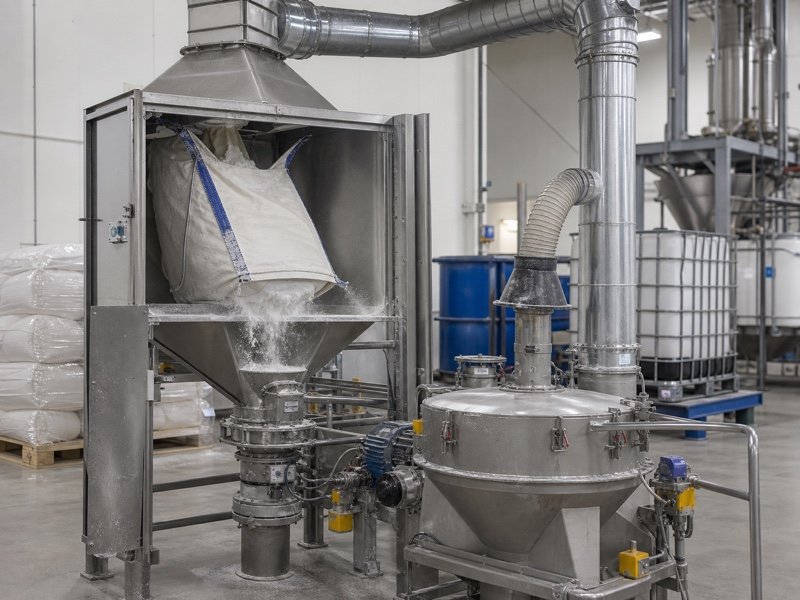
Chemical powder dust can be generated during bag dumping, manual feeding, weighing, batching, mixing, blending, milling, screening, conveying, silo venting, filling, and packaging. Dust often escapes when powder drops from one process step to another or when air movement disturbs fine material near an open point.
Common dust points include sack tipping stations, mixer charging ports, blender discharge points, screw conveyor transfer points, pneumatic conveying receivers, packaging machines, and bulk bag unloading stations.
The dust source may look small, but fine powder can spread quickly around platforms, floors, equipment frames, and operator work areas. For this reason, source capture is usually more important than general room ventilation.
Dust Characteristics and Collection Challenges
Chemical powders vary widely. Some are fine and dry, some are sticky or hygroscopic, some are abrasive, and some may react with moisture or create corrosion concerns. A dust collector that works well for one chemical powder may not be suitable for another.
The main challenge is matching the filter and cleaning method to the powder behavior. Fine dry powder often needs high-efficiency filtration and stable pulse cleaning. Sticky or moist powder may blind filters. Abrasive powder can affect duct, hopper, and filter life. Corrosive dust or gas may require material or coating review.
Before selection, we usually ask for the powder name, particle size, moisture, temperature, dust load, whether the powder is waste or product recovery, and whether any safety data is available.
Recommended Dust Collector for Chemical Powder
For local chemical powder feeding, weighing, small mixers, and packaging points, a cartridge dust collector is often a practical first option. It has a compact footprint and works well for many fine dry powders when the dust load is moderate and the filter media is selected correctly.
For central systems serving several mixers, conveyors, silos, or packaging lines, a baghouse dust collector is often more suitable. Baghouse systems can handle larger airflow and heavier dust loading, especially when the process runs continuously.
A cyclone dust collector may help as a pre-separator if the process produces coarse particles or high dust load, but it is usually not enough as the final filter for fine chemical powder. A portable dust collector may be used for temporary or local maintenance points when the process conditions are simple.
For a broader equipment comparison, the existing guide on baghouse vs cartridge dust collector can help with early selection.
Chemical Powder Dust Collection System Layout
A practical chemical powder dust collection system starts from the dust source. The capture method may be an enclosed bag dumping cabinet, local hood, mixer charging hood, receiver vent filter, branch duct connection, or enclosed transfer point.
For one workstation, the layout may include a hood or enclosure, short duct, compact cartridge collector, fan, and dust bin. For multiple production points, the system may need branch ducts, balancing dampers, a central baghouse or cartridge collector, fan, control panel, and dust discharge equipment.
Keep the duct route as direct as possible. Long horizontal runs, low conveying velocity, and unnecessary elbows can allow powder to settle inside the duct. If the collected powder must be recovered, the hopper and discharge method should also be reviewed.
Key Selection Factors
Before selecting a chemical powder dust collector, review the process details first.
| Factor | What to check |
|---|---|
| Process | Bag dumping, feeding, mixing, milling, conveying, silo venting, or packaging. |
| Powder behavior | Fine, dry, sticky, moist, abrasive, corrosive, or hygroscopic. |
| Dust points | Number of capture points and how many run at the same time. |
| Airflow | Hood size, machine port size, duct length, branch quantity, and pressure loss. |
| Dust handling | Waste dust, product recovery, sealed discharge, or easy bin removal. |
| Safety | Combustible dust, static control, temperature, corrosive gas, and site rules. |
If airflow is unclear, start with the hood size, dust source opening, number of working points, and layout drawing. The guide on how to calculate airflow for a dust collection system can help with early planning.
Safety and Special Design Considerations
Chemical powder applications should be reviewed carefully before final design. Some powders may be combustible, static-sensitive, corrosive, toxic, or difficult to clean from filters and hoppers.
If combustible dust is possible, explosion protection, isolation, grounding, and local safety requirements should be reviewed by qualified parties before installation. If the powder is corrosive or the gas stream contains chemical vapor, dry dust collection may need special material, coating, or a different air treatment approach.
Do not connect incompatible powders, wet chemical exhaust, or corrosive vapor into the same dry dust collector without checking the process. The Application page should stay practical, so detailed combustible dust and filter media discussions are planned as separate Blog topics.
Why Choose Novazure for Chemical Powder Dust Collection
Novazure provides practical industrial dust collector systems for chemical powder handling, including cartridge collectors, baghouse collectors, fans, ductwork, controls, and related system components.
For chemical powder projects, we help review the powder type, dust source, capture method, airflow, dust load, filtration needs, discharge method, and installation space. Instead of only quoting a standard collector, we help match the collector type and system layout to the actual production process.
If your process is closer to general material transfer, you can also review our bulk powder and material handling dust collection page. For other industries, the dust collection applications hub can help you compare related dust control scenarios.
FAQ
For many fine dry chemical powders, a cartridge dust collector is suitable for local or medium-airflow sources. For larger airflow, heavy dust load, or multiple continuous dust points, a baghouse dust collector may be more practical.
Yes, if the powder is fine, dry, and not too sticky or moist. The filter media, cleaning method, airflow, and dust discharge should still be selected according to the actual powder properties.
Usually not as the final filter. A cyclone can help separate coarse particles or reduce load before a final dust collector, but fine chemical powder normally needs cartridge or baghouse filtration.
Send the powder name, process type, dust source photos, number of collection points, airflow requirement if known, operating temperature, moisture condition, dust load, recovery requirement, and site layout.
Request a Chemical Powder Dust Collection Solution
If you need a dust collection system for chemical powder bag dumping, mixing, conveying, milling, filling, or packaging, send us your powder information, dust source, airflow requirement, working points, and layout drawing.
Novazure will help you review whether a cartridge dust collector, baghouse dust collector, local capture unit, or central chemical powder dust collection system is more suitable for your production line.