
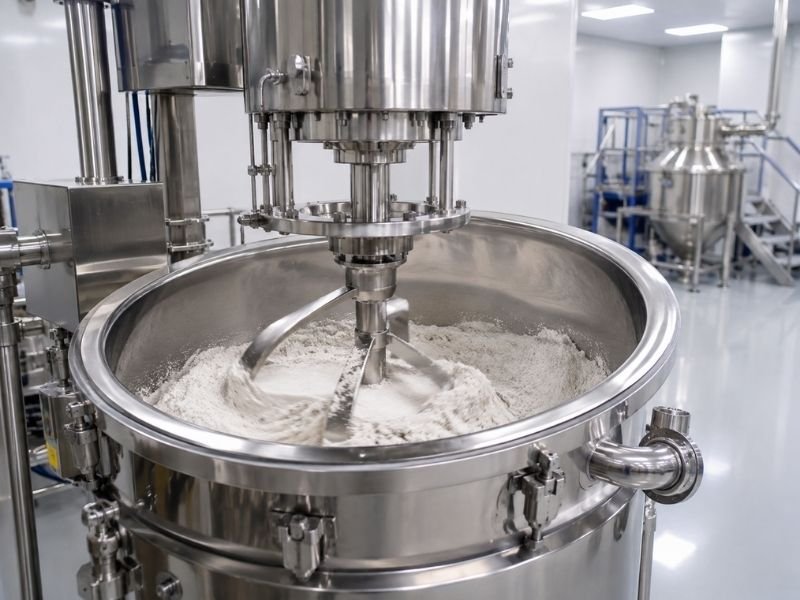
Mixing & Blending Dust Collection — Quick Guide
Jump to the part you need — charging, mixer venting, discharge, contamination control, collector selection, or project data.
Why Mixing & Blending Needs a Different Dust Control Strategy
Mixing and blending dust control is not only about capturing powder at an open machine. The process often includes repeated ingredient charging, displaced air from the vessel, internal agitation, discharge into downstream equipment, and frequent batch changeover. Each stage can create a different path for dust to escape.
The Mixer Is a Vessel That Breathes as Material Enters and Leaves
When powder is charged into a mixer, the incoming material occupies volume and pushes air out of the vessel. When mixed product is discharged, another air movement occurs through the receiving equipment. Dust control therefore depends on giving this air a controlled, filtered path instead of allowing it to escape through lids, loading ports, seals, or discharge openings.
Repeated Ingredient Charging
Multiple powders may be added manually or automatically, creating repeated dust-release events during every batch.
Displaced Air
Incoming powder pushes air out of the mixer or blender. If the vent path is uncontrolled, that air can carry fine dust into the room.
Internal Agitation
Ribbon, paddle, ploughshare, cone, tumble, or high-shear mixing can suspend fine material inside the vessel even when the external process looks contained.
Frequent Changeover
Opening, cleaning, inspection, and product changeover can re-suspend deposited powder and increase cross-contamination risk.
Control the air path around the batch process.
Effective mixing dust collection usually starts with containment, controlled venting, and local extraction at charging and discharge points. Collector size should then be based on the actual airflow and dust loading created by the process—not simply the mixer volume or motor power.
Dust Control During Mixer Charging and Ingredient Addition
Charging is often one of the most visible dust-release stages in a batch mixing process. The control approach should match how ingredients are introduced—manual bag dumping, bulk bag discharge, vacuum transfer, screw feeding, or closed conveying all create different air and dust conditions.
Manual Bag Dumping
Opening and emptying bags can release a short, concentrated dust cloud close to the operator and mixer charging port.
Bulk Bag / FIBC Charging
The connection between the bulk bag discharge spout and the receiving hopper or mixer should remain as contained as practical.
Automated Powder Feeding
Screw feeders, vacuum conveyors, and closed transfer systems reduce open handling but still require attention at receiver vents and connection points.
Minor Ingredient Addition
Small-dose ingredients can be highly dust-prone even when the total mass is low, particularly when operators scoop, weigh, and manually add fine powders.
Capture the dust where powder crosses from open handling into the mixer.
A well-designed charging station reduces how much dust reaches the room in the first place. This is often more effective than relying on general room ventilation or simply increasing the dust collector airflow after the dust has already dispersed.
Control the Air Displaced When Powder Enters the Mixer
Every batch addition changes the air volume inside the mixer or receiving hopper. If displaced air has no controlled route, it can escape through charging ports, lids, seals, or inspection openings and carry fine powder into the surrounding area.
Let the Vessel Breathe Through a Controlled Filtered Path
The mixer vent or receiver vent should relieve displaced air without creating excessive suction that pulls useful product out of the process. Airflow, vent location, filter resistance, and ingredient charging rate should be evaluated together.
Charging Rate
Fast powder addition can create a short but intense displaced-air event that differs from steady process ventilation.
Mixer Free Volume
Vessel geometry and fill level affect how much air is displaced and how pressure behaves during charging.
Vent Position
A vent close to the powder entry point may experience heavier product carryover than a better-positioned connection.
Filter Resistance
As filters load, available vent airflow can decrease unless the system is sized and cleaned appropriately.
Control Dust When the Mixed Product Leaves the Blender
The end of the mixing cycle creates a new dust-control condition. Product may fall rapidly into a bin, bag, conveyor, sifter, mill, packaging line, or pneumatic transfer system. Drop height, discharge rate, and the receiving equipment determine how much dust and displaced air are generated.
Mixer Outlet
The discharge valve releases the blended powder into the downstream process.
Drop / Transfer
Free fall and product acceleration can entrain air and increase dust generation.
Receiving Equipment
Bins, bags, conveyors, sifters, or hoppers need a path for displaced air to escape.
Next Process
The product may continue to milling, granulation, filling, packaging, storage, or another mixing stage.
High Drop Height
Long free-fall distances can increase particle dispersion and entrained air, especially with low-density powders.
Fast Batch Dumping
A large batch released quickly can create a short-duration dust and airflow peak that is different from steady ventilation.
Product Recovery
If the dust collector captures saleable product, recovery and contamination control should be considered in the discharge design.
Reduce Powder Migration and Cross-Contamination Around Mixing Operations
Mixing lines often handle several ingredients, formulations, colors, grades, or batches on the same equipment. Dust collection should support the required level of material separation without creating unnecessary shared dust paths between products that should remain isolated.
A Shared Dust System Can Connect Processes That Are Otherwise Separate
If several mixers or charging stations connect to one common duct and collector, captured material from different products may enter the same air path. Whether that is acceptable depends on the application, hygiene requirements, product compatibility, hazard assessment, and cleaning strategy.
Product Changeover
Residual powder can remain in the mixer, ductwork, filters, hopper, or discharge equipment between batches.
Shared Ductwork
Common branches can connect several process areas and may require isolation or cleaning considerations.
Collector Dust Handling
Recovered dust from mixed products may not be suitable for reuse and may need controlled disposal.
Cleaning Access
Filters, hoppers, ducts, and capture connections should support the cleaning strategy required by the process.
Selecting a Dust Collector for Mixing & Blending Operations
Collector selection should reflect the ingredient properties, dust loading, charging and discharge pattern, cleaning requirements, product compatibility, operating schedule, and whether the process needs dedicated or shared collection.
Cartridge Dust Collector
Cartridge filtration can be evaluated for dry, fine ingredients and moderate dust loading when the powder is compatible with pleated media. It can suit local charging stations or medium-size systems serving several mixer vents and transfer points.
Dry fine powder · Moderate loading · Compact footprint · Local or medium-size system
Baghouse Dust Collector
A baghouse may be more appropriate for higher dust loading, larger airflow, continuous powder handling around multiple mixers, or material conditions that benefit from a different filter-media format and dust-holding capacity.
Higher loading · Large airflow · Continuous duty · Centralized collection · Special media needs
Portable or Compact Dust Collector
For a single manual charging point, pilot mixer, small batch process, or isolated work area, a compact local collector can reduce duct length and keep extraction independent from the wider plant system.
Single station · Small batch · Flexible layout · Independent extraction · Short duct run
Sticky, hygroscopic, abrasive, potent, or combustible powders can change the design.
Filter media, cleaning method, dust discharge, containment, isolation, and protection measures should be selected from actual material and process data. The mixer type alone does not determine the collector.
Information Needed to Design a Mixing & Blending Dust Collection System
You do not need to know the final airflow before contacting us. Mixer details, charging method, ingredient properties, batch size, charging and discharge rates, vent connections, downstream equipment, and site layout are usually enough to begin a preliminary engineering review.
Mixer & Charging Equipment
Equipment data helps identify openings, vent connections, charging points, discharge geometry, and available extraction interfaces.
Ingredients & Dust Properties
Material properties influence capture, filter selection, cleaning, contamination control, dust discharge, and hazard evaluation.
Batch & Operating Conditions
Batch size and how quickly material is charged or discharged can affect displaced-air peaks and dust loading.
Downstream & Site Information
Receiving equipment, duct routing, room conditions, utilities, and cleaning strategy influence the final system arrangement.
From Mixing Data to Dust Collection Configuration
These inputs help us evaluate the required extraction arrangement for charging, mixer venting, discharge, filtration, fan duty, and collected-dust handling.
Capture Points
Required Airflow
Static Pressure
Collector / Media
Fan Selection
Dust Discharge
Related Mixing & Blending Dust Collection Guides & Solutions
Mixing and blending are common across pharmaceutical, food, chemical, battery-material, pigment, plastic, feed, and other powder-processing industries. Explore related applications, products, and technical guidance for the wider dust collection system.
Powder Processing
Industry Context
Dust Collection Equipment
Engineering Resources
Mixing is a process application used across many industries.
The dust collection principles are broadly applicable, but the final system should reflect the actual ingredients, hygiene requirements, batch process, charging and discharge method, product compatibility, dust properties, and site-specific hazard controls.