
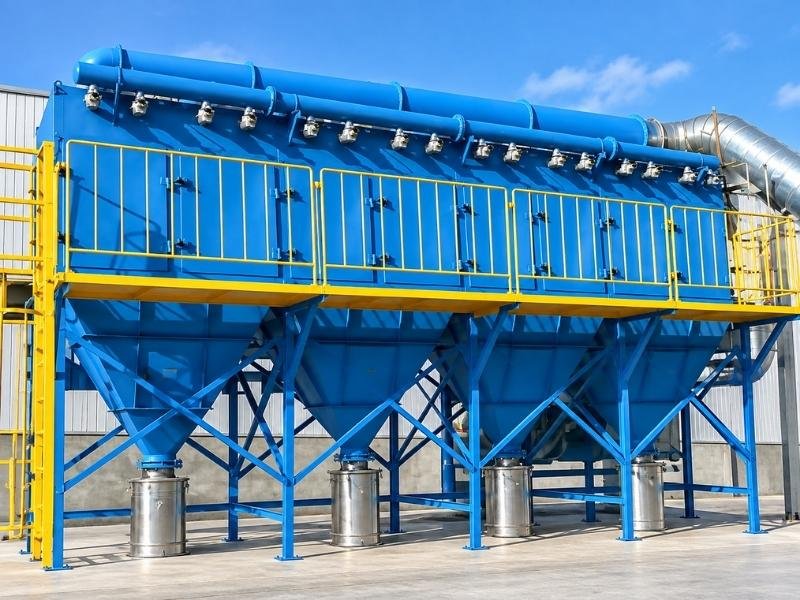
Industrial Pulse-Jet Baghouse Dust Collector for Continuous Filtration
Novazure designs and manufactures pulse-jet baghouse dust collectors for industrial processes requiring reliable filtration, automatic cleaning and continuous dust collection. This type of pulse jet dust collector combines fabric filtration with compressed-air cleaning for stable operation under demanding industrial conditions.
As a widely used configuration of industrial baghouse dust collectors , the pulse-jet design allows accumulated dust to be removed from the filter bags without frequent shutdowns, making it suitable for continuous-duty applications.
Each system can be configured according to airflow, dust loading, particle characteristics, operating temperature, filter media, air-to-cloth ratio, cleaning requirements and target emission performance.
Request a QuoteHow Does a Pulse-Jet Baghouse Dust Collector Work?
A pulse-jet dust collector separates particulate from the process air through fabric filtration. Dust is captured on the surface of the filter bags , while cleaned air passes through the filter media and leaves the collector.
As dust builds on the filter surface, the pulse-jet cleaning system periodically removes the accumulated dust so filtration can continue with a controlled pressure drop.
Pulse cleaning can be controlled by time intervals or differential pressure, depending on the system configuration and operating requirements.
Dust-Laden Air Enters the Collector
Process air carrying dust enters the baghouse and is distributed through the dirty-air section of the collector.
Dust Is Captured by the Filter Bags
The air passes through the filter media while particulate is retained on the bag surface, gradually forming a dust layer.
Clean Air Leaves the Baghouse
After passing through the filter media, the cleaned air enters the clean-air section and is discharged through the collector outlet.
Compressed Air Pulses Clean the Bags
A pulse valve releases a short burst of compressed air through the blow pipe, creating a rapid cleaning action that dislodges dust from the filter surface.
Collected Dust Falls Into the Hopper
Released dust falls into the hopper and is removed through the selected discharge arrangement for collection or further handling.
Automatic Pulse-Jet Cleaning for Stable Filter Performance
The pulse-jet cleaning system uses short bursts of compressed air to remove accumulated dust from the filter bags. Effective cleaning helps control pressure drop, maintain airflow and support continuous baghouse operation.
Compressed Air Header
Stores compressed air and supplies the pressure required for each cleaning pulse.
Pulse Valves
Rapid-opening valves release controlled bursts of compressed air during the cleaning sequence.
Blow Pipes & Venturis
Direct the cleaning pulse into each filter bag and help distribute the cleaning energy effectively.
Cleaning Controller
Controls pulse duration, cleaning intervals and valve sequence according to the selected operating strategy.
How Pulse-Jet Filter Cleaning Is Controlled
The cleaning sequence can be configured according to the process and dust loading. The objective is to remove enough accumulated dust to maintain stable resistance without cleaning the filter bags more frequently than necessary.
Timer-Based Cleaning
Pulse valves operate according to preset cleaning intervals and pulse durations.
Differential-Pressure Cleaning
Cleaning is initiated according to the pressure difference across the filter section, allowing the system to respond to actual dust loading.
Cleaning frequency matters. Excessive pulsing can increase compressed-air consumption and mechanical stress on the filter bags, while insufficient cleaning can allow pressure drop to rise and reduce system airflow.
Key Design Parameters for a Pulse-Jet Baghouse
A pulse-jet baghouse should be sized around the actual process rather than selected only by airflow. Dust properties, filtration velocity, operating temperature and cleaning requirements all influence the final equipment configuration.
Required Airflow
The required process airflow influences collector size, filtration area, inlet and outlet dimensions, and the selection of the system fan.
Air-to-Cloth Ratio
The air-to-cloth ratio determines how much airflow passes through the available filter area and directly affects collector size, pressure drop and filter loading.
Dust Characteristics
Particle size, dust concentration, abrasiveness, moisture and stickiness should be considered when selecting filtration conditions and internal equipment configuration.
Filter Media
Filter media should be selected according to operating temperature, gas composition, humidity, particle characteristics and required filtration performance.
Cleaning Arrangement
Pulse-valve quantity, blow-pipe arrangement, cleaning sequence and control method should match the filter area and expected dust loading.
Operating Pressure Drop
Maintaining a suitable pressure-drop range helps preserve system airflow while avoiding unnecessary fan energy and excessive loading on the filter bags.
Final filter area, bag quantity, pulse-valve arrangement, dimensions and system configuration are determined according to the confirmed process conditions and approved engineering design.
Configure the Pulse-Jet Baghouse Around Your Process
Pulse-jet baghouse systems can be configured according to dust characteristics, operating temperature, corrosion conditions, discharge requirements, controls and site-specific operating needs.
Housing & Construction
Housing material and structural configuration are selected according to the process environment, corrosion exposure and project requirements.
Filter Media
Filter media is matched to temperature, moisture, chemical exposure, particle characteristics and required filtration performance.
Cleaning Control
Cleaning strategy can be configured according to operating schedule, pressure-drop behavior and automation requirements.
Dust Discharge
Dust discharge equipment is selected according to collected dust volume, operating continuity and downstream handling requirements.
Fan & Airflow Control
Fan airflow and static pressure are selected according to the collector resistance and overall system operating requirements.
Electrical & Monitoring
Electrical controls and monitoring functions can be configured to match the required level of automation and plant interface.
Some Applications Require Additional Engineering
Temperature and combustible-dust conditions can significantly affect filter media, construction materials, controls and safety configuration.
High-Temperature Operation
Elevated gas temperatures may require suitable filter media, materials and thermal design considerations.
Combustible Dust
Combustible-dust applications require project-specific assessment and suitable explosion-protection and antistatic configurations.
Final configuration is project-specific. Available materials and components are selected according to the confirmed process conditions, operating requirements and approved engineering design.
Where Pulse-Jet Baghouse Dust Collectors Are Commonly Used
Pulse-jet baghouses are widely used in industrial processes that generate dry particulate and require continuous filtration with automatic filter cleaning.
Cement & Mineral Processing
Dust collection for cement, limestone, mineral powders and other dry particulate generated during industrial processing.
Powder Handling & Mixing
Captures airborne dust generated during feeding, mixing, blending and handling of dry powders and bulk materials.
Grinding, Crushing & Screening
Suitable for processes that generate continuous particulate during grinding, crushing, screening and related material preparation.
Bulk Material Transfer
Controls dust released at conveyors, transfer points, loading areas and other locations where dry bulk solids are moved.
Silo & Bin Venting
Provides filtration for dust displaced during pneumatic filling, material storage and ventilation of silos and process bins.
Metal & General Industrial Processing
Used for selected dry particulate generated by metal processing, material preparation and other continuous industrial operations.
Suitability should be confirmed according to dust characteristics, temperature, moisture, abrasiveness, combustible-dust risk and required emission performance. The final collector configuration is selected according to the actual process conditions.
Pulse-Jet Baghouse FAQs
Common questions about pulse-jet baghouse operation, filter cleaning, pressure drop and system selection.
What is a pulse-jet baghouse dust collector?
A pulse-jet baghouse is a dry dust collector that uses fabric filter bags to separate particulate from an industrial air stream. Accumulated dust is periodically removed from the bags by short pulses of compressed air, allowing the collector to maintain filtration performance during continuous operation.
How often should pulse-jet filter cleaning occur?
There is no single cleaning interval suitable for every system. Cleaning frequency depends on dust loading, filtration velocity, pressure drop, filter media and operating conditions.
Pulse cleaning can be controlled by preset time intervals or by differential pressure so the cleaning sequence responds to actual filter loading.
What causes high pressure drop in a pulse-jet baghouse?
High pressure drop can result from excessive dust accumulation, insufficient pulse cleaning, unsuitable filter media, excessive airflow, sticky or moisture-sensitive dust, or problems with the compressed-air cleaning system.
The cause should be evaluated together with airflow, differential pressure trends and the actual condition of the filter bags.
What filter media can be used in a pulse-jet baghouse?
Common filter media include polyester, PPS, aramid, PTFE and antistatic materials. The appropriate filter bag depends on operating temperature, moisture, gas chemistry, dust characteristics and required filtration performance.
What is the difference between a pulse-jet and reverse-air baghouse?
A pulse-jet baghouse uses short bursts of compressed air to clean the filter bags. Reverse-air baghouses use a lower-pressure reverse airflow to remove the accumulated dust cake.
The two designs differ in cleaning method, filter-bag arrangement, equipment configuration and typical operating strategy. Selection depends on the process, dust characteristics and required system design.