
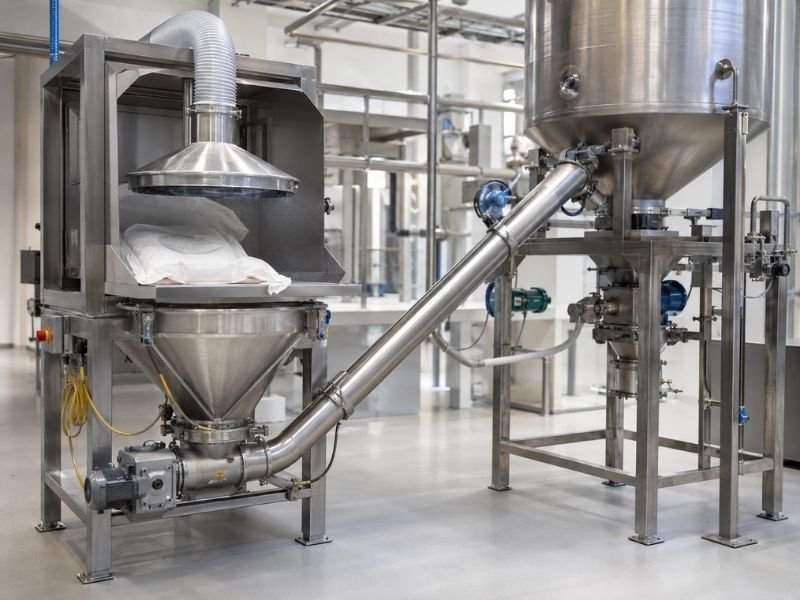
Where Dust Is Generated During Powder Handling
Powder handling can release airborne dust whenever material is opened, dropped, transferred, conveyed, stored, discharged, or packaged. Dust generation is usually concentrated at transfer points, openings, and locations where incoming powder displaces air from a hopper, bin, bag, or process vessel.
Follow the Material Through the Transfer Path
Effective dust collection starts by identifying where powder changes direction, falls through an opening, enters a vessel, or leaves one piece of equipment for another. These points often create local air movement that can carry fine particles into the surrounding area.
Bag & Sack Emptying
Manual opening and emptying of bags can release dust around the operator, bag opening, tipping edge, and receiving hopper as powder falls and air is displaced.
Bulk Bag / FIBC Discharging
Dust may escape around the discharge spout, tie-off connection, or hopper inlet if the bulk bag connection is not sufficiently sealed or vented.
Hopper & Bin Loading
Incoming powder can displace air from a hopper, bin, or vessel. That displaced air may carry fine particles out through openings, vents, access covers, or poorly sealed connections.
Powder Transfer
Pneumatic, gravity, or mechanical transfer can create dust where material enters or leaves equipment, particularly at open transitions and connection points.
Conveyors & Screw Transfers
Conveyor inlets, outlets, screw discharge points, and equipment transitions can release dust when powder changes speed, direction, or elevation.
Discharge & Packaging
Powder filling into bags, drums, boxes, or other containers can release dust as the receiving container fills and displaced air exits around the filling point.
The most effective capture point is usually close to the actual transfer or air-displacement location. Enclosing the dust source where practical can reduce the airflow required compared with trying to capture dust after it has already dispersed into the room.
Key Dust Capture Points for Powder Handling
Powder handling dust control is most effective when extraction is placed at the transfer point before airborne particles spread into the work area. Capture design should account for enclosure, opening size, powder flow, displaced air, operator access, and the way material moves through each process connection.
Capture Displaced Air at the Transfer Point
When powder enters a hopper, bin, bag, or vessel, it displaces air. If that air has no controlled escape path, it can carry dust through nearby openings. A practical extraction design manages both the powder-release point and the air movement created by the transfer process.
Bag Dump Station
Manual bag opening and tipping can release dust directly into the operator breathing zone and surrounding work area.
Use an Enclosed or Back-Draft Capture Zone
Position extraction behind or around the receiving opening so airflow moves dust away from the operator and toward the collection system while maintaining practical access for bag handling.
Opening Control
Face velocity · Operator access · Hopper opening
Bulk Bag / FIBC Discharge
Dust can escape around the bulk bag spout as powder enters the receiving hopper and air is displaced upward.
Seal the Connection and Vent the Receiving Hopper
Use a controlled spout connection where practical and provide extraction or venting close to the receiving zone to manage displaced air without pulling excessive product into the duct.
Displaced Air
Spout seal · Vent path · Fill rate
Hopper & Bin Loading
Powder entering a vessel can pressurize the free space and push dust-laden air through covers, inspection ports, or other openings.
Provide Controlled Venting or Local Extraction
Ventilation should be sized around the actual filling method, transfer rate, vessel geometry, and available vent area so the vessel does not release dust through unintended openings.
Vessel Venting
Filling rate · Enclosure · Vent location
Conveyor & Transfer Points
Dust may be released where powder falls from one conveyor, screw, chute, or processing machine into another piece of equipment.
Enclose the Drop Zone and Extract from the Enclosure
Reducing open area around the transfer point can limit dust escape and allow a smaller, more controlled airflow to pull suspended particles toward the duct connection.
Transfer Enclosure
Drop height · Enclosure leakage · Duct location
Packaging & Filling
Filling bags, drums, or containers can displace air and release fine powder around the filling nozzle and container opening.
Capture Around the Filling Interface
Local extraction can be positioned around the fill point or connected to an enclosed filling head so the air leaving the container is drawn toward the dust collector rather than into the room.
Container Filling
Fill rate · Nozzle clearance · Air displacement
Enclose Before Increasing Airflow
Reducing the open area around a transfer point can improve dust capture without relying on unnecessarily high exhaust volume.
Control Product Loss
Extraction should capture airborne dust without pulling excessive saleable powder away from the process.
Maintain Process Access
Hoods and duct connections should allow normal bag handling, inspection, cleaning, maintenance, and equipment changeover.
Airflow & Static Pressure Considerations for Powder Handling
Powder handling dust collection should not be sized from one universal CFM value. Required airflow depends on the size and enclosure of each dust source, the way powder is transferred, the number of points operating simultaneously, the duct network, and the resistance of the selected dust collector and filter media.
More Airflow Is Not Automatically Better
A poorly enclosed transfer point can require large airflow and still allow dust to escape. A better approach is to control the opening, understand the displaced-air path, and then provide enough extraction to maintain inward airflow toward the dust collection connection.
Start with the dust source and enclosure. Then determine the capture airflow, transport requirement, system pressure loss, and fan duty for the complete extraction path.
Opening Size & Enclosure
An open bag dump station, enclosed hopper, sealed bulk bag connection, and enclosed conveyor transfer point can require very different capture airflow.
Drop Height & Transfer Rate
Higher material drop, faster filling, or larger powder throughput can increase turbulence and the volume of dust-laden air generated around the transfer point.
Simultaneous Operation
A central system should maintain suitable airflow when several transfer points, bag dump stations, conveyors, or filling lines operate at the same time.
Duct & Collector Resistance
Duct diameter, length, elbows, branches, transport velocity, pre-separation equipment, filter media, and dust loading all affect the static pressure the fan must overcome.
From Dust Source to Fan Selection
Airflow and static pressure should be evaluated together so the fan can deliver the required capture performance at the actual operating points.
Dust Sources
Identify openings, transfer points, and operating conditions.
Capture Airflow
Determine the airflow needed to control each active source.
Transport & Duct Loss
Size the duct network and calculate resistance through the air path.
Collector Resistance
Include filters, pre-separation, inlet, outlet, and dust-loading effects.
Fan Selection
Select fan airflow and static pressure for the complete system.
Consider the Entire Air Path
For a more detailed explanation of airflow estimation, capture requirements, duct velocity, pressure loss, and fan selection, see our dust collection airflow calculation guide.
Dust Collection Airflow Calculation →Powder Characteristics That Affect Dust Collection Design
The same powder handling process can require very different dust collection equipment depending on particle size, bulk density, moisture, stickiness, abrasiveness, and combustible-dust characteristics. These properties influence capture behavior, duct design, filter selection, cleaning performance, dust discharge, and system protection.
The Process Name Alone Is Not Enough for Collector Selection
A bag dump station handling lightweight food powder may behave very differently from one handling abrasive mineral dust or sticky chemical powder. Collector selection should therefore be based on both the handling process and the actual material.
Fine Particle Size
Fine particles can remain suspended, travel with displaced air, and escape through small openings if capture is not located close to the powder-release point.
Source capture · Filter efficiency · Leakage control
Bulk Density
Lightweight powders may become airborne easily, while denser materials can increase hopper loading, dust discharge requirements, and wear in material-handling components.
Airborne behavior · Dust loading · Hopper and discharge design
Cohesiveness or Stickiness
Sticky or cohesive powders can adhere to ductwork, filter media, hoppers, rotary valves, and discharge equipment, making cleaning and material removal more difficult.
Filter media · Cleaning method · Hopper geometry
Moisture & Hygroscopicity
Moist or hygroscopic powder can agglomerate, bridge, cake on filters, and increase resistance if humidity or process moisture changes the material during handling.
Filter loading · Cleaning performance · Dust discharge
Abrasiveness
Abrasive mineral, cement, metal, or other hard particles can wear ducts, elbows, collector inlets, rotary valves, and other components exposed to high particle velocity.
Duct velocity · Wear protection · Material selection
Combustibility
Some powders can present combustible-dust hazards. The need for explosion protection or other safety measures should be evaluated from actual material data, process conditions, and applicable site requirements.
Hazard evaluation · System arrangement · Protection measures
Send Us the Actual Powder Information When Available
Material name, particle size, bulk density, moisture, stickiness, abrasiveness, dust concentration, and combustible-dust data can help determine whether cartridge filtration, bag filtration, cyclone pre-separation, or another configuration is appropriate.
Recommended Dust Collectors for Powder Handling
There is no single dust collector that fits every powder handling process. Collector selection should reflect particle size, dust loading, moisture, stickiness, abrasiveness, airflow, process duty, available space, and whether coarse material should be separated before final filtration.
Cartridge Dust Collector
Cartridge dust collectors are often evaluated for dry, fine powder applications where a compact footprint and high filter area are useful. They can serve individual transfer stations or centralized systems when the powder remains suitable for cartridge filtration and the dust loading is within a practical range.
Suitable for many fine, dry powders when the material is not excessively sticky or difficult to clean from pleated media.
Pleated filter area allows a relatively compact collector for local or medium-sized powder handling systems.
Can be configured for bag dumping, transfer points, packaging, or multiple branches when the system is properly sized and balanced.
Baghouse Dust Collector
A baghouse can be considered for higher dust loading, larger airflow, continuous powder handling, or materials that are better suited to bag filtration and different filter-media options.
High dust load · Large airflow · Continuous duty · Bag media preferred
Cyclone Dust Collector
A cyclone can be used as a pre-separator when the process carries a significant amount of coarse or heavy particulate. Removing that material before final filtration can reduce the dust load reaching a downstream cartridge or baghouse collector.
Coarse particles · Heavy loading · Material recovery · Pre-separation before final filters
Powder properties and process duty determine the final collector type.
A portable dust collector may also be considered for a small, isolated, or intermittent powder handling point. Sticky powder, moisture, very high dust loading, abrasive material, or combustible dust can change the preferred system configuration.
Typical Powder Handling Dust Collection System Configuration
A powder handling dust collection system combines source capture, ductwork, optional pre-separation, filtration, airflow generation, dust discharge, and controls. The exact arrangement depends on the powder, transfer equipment, number of active dust points, operating schedule, and site layout.
Design the Complete Transfer and Airflow Path
Effective dust control depends on how the capture hood, enclosure, branch duct, main duct, pre-separator, dust collector, fan, and final discharge work together. The collector alone cannot compensate for an open transfer point or poorly balanced duct network.
Powder Handling Equipment
Dust is generated at bag dumping, bulk bag discharge, hopper loading, conveyors, transfer points, or packaging equipment.
Dust SourceHood / Enclosure
Local capture or enclosure controls airborne dust and displaced air close to the transfer point.
Source CaptureDuct Network
Branch and main ducts convey collected air while maintaining practical velocity and pressure balance.
Transport + BalancingPre-Separator
A cyclone or other pre-separation stage can be added when coarse or heavy particulate should be removed before final filtration.
If RequiredDust Collector
Fine dust is separated from the airflow using cartridge, bag, or another filtration technology selected for the material and process.
Cartridge · Baghouse · Other Explore Dust Collectors →Centrifugal Fan
The fan provides the airflow and static pressure needed to move air through the complete extraction and filtration system.
Airflow + Static PressureClean Air Discharge
Final air discharge or additional filtration is selected according to process, emission, building, and project requirements.
Final Air HandlingAdditional Components Depend on the Powder and Process
Not every powder handling system needs the same accessories. Supporting components should be selected according to material behavior, dust loading, system layout, discharge method, maintenance, and safety requirements.
Airflow Dampers
Branch dampers can help balance airflow between multiple transfer points and operating zones.
Pulse-Jet Cleaning
Automatic compressed-air cleaning helps remove accumulated dust from suitable filter elements during operation.
Differential Pressure Monitoring
Pressure-drop monitoring helps track filter loading and cleaning performance.
Rotary Valve & Dust Discharge
Collected material can discharge to a bin, rotary valve, screw conveyor, or project-specific recovery and disposal arrangement.
Control Panel
Controls can coordinate fan operation, pulse cleaning, monitoring, alarms, dampers, and other system functions.
Explosion Protection
Additional protection should be evaluated when actual material data and process conditions indicate a combustible-dust hazard.
Not Every Powder Handling System Needs a Cyclone
A cyclone can be useful when the airstream carries enough coarse or heavy material to justify pre-separation. Fine-only applications may be better served by direct filtration. The decision should be based on particle size, dust load, material recovery, abrasion, and downstream filter requirements.
Local vs Central Dust Collection for Powder Handling
Powder handling points can use dedicated local collectors or connect to a centralized dust collection system serving multiple stations. The best arrangement depends on dust-source quantity, simultaneous operation, material compatibility, duct distance, production flexibility, and maintenance strategy.
Local / Dedicated Dust Collection
A dedicated collector serves one bag dump station, filling point, transfer machine, or small group of nearby dust sources. This can provide flexibility when materials or process areas should remain separated.
One collector located close to one powder handling station or a limited group of nearby transfer points.
Shorter duct runs, independent operation, easier material separation, simpler balancing, and flexibility when equipment is moved or changed.
Multiple collectors may require separate filter maintenance, dust bins, compressed air, electrical controls, and installation space.
Dedicated extraction can help avoid mixing dust from materials that should remain separate for product, sanitation, recovery, or hazard reasons.
Single stations · Different materials · Short duct runs · Intermittent operation · Flexible layouts
Central Dust Collection System
A central system connects several fixed powder handling points through a common duct network and processes the collected air through a shared dust collector, fan, dust discharge, and control system.
Multiple bag dump stations, hoppers, conveyors, transfer points, or filling machines connected to one centralized system.
Centralized filtration, common dust discharge, coordinated controls, fewer collector units, and maintenance concentrated at one location.
Branch balancing, static pressure, simultaneous operation, material compatibility, shutdown strategy, and future expansion require careful engineering.
Materials that should not mix may require separate branches, separate collectors, or a different system arrangement rather than a common centralized network.
Multiple fixed sources · Stable layouts · Compatible materials · Continuous duty · Centralized maintenance
Six Factors We Compare
The decision should reflect how the powder handling area actually operates rather than assuming that local or central extraction is always the better option.
Dust Source Quantity
One isolated source may favor a dedicated collector, while many nearby fixed sources can make centralized extraction more practical.
Simultaneous Operation
The system should maintain suitable airflow when multiple transfer points operate at the same time.
Material Compatibility
Different powders should only share a system when product, sanitation, chemical, recovery, and hazard considerations permit it.
Duct Distance & Pressure Loss
Longer centralized duct networks can increase resistance and make branch balancing more important.
Production Flexibility
Frequent equipment moves, changing products, or temporary process points can favor a more modular or dedicated arrangement.
Maintenance Strategy
Compare centralized maintenance with the flexibility of servicing a local collector without affecting other powder handling points.
Different Powders Do Not Always Belong in the Same Dust System
A common central system can simplify dust collection for compatible materials and fixed production areas. Separate systems may be more appropriate when powders have different contamination, recovery, chemical, abrasive, combustible, or maintenance requirements.
Information Needed for Powder Handling Dust Collection Design
You do not need to calculate the complete dust collection system before contacting us. Basic information about the handling process, powder, throughput, operating schedule, and installation site is usually enough to begin a preliminary engineering review.
You Do Not Need to Know the CFM Before Contacting Us
If airflow and static pressure have already been calculated, we can include those values in the review. If they are not available, process drawings, equipment dimensions, transfer method, material properties, throughput, and operating schedule can provide a practical starting point for preliminary system sizing.
Process type + powder information + handling capacity + active dust points + installation layout are often enough to begin the first engineering discussion.
Process & Equipment Information
Process information helps identify the actual dust sources, opening sizes, transfer path, capture locations, and whether extraction should be local or centralized.
Powder & Dust Information
Material behavior influences filtration technology, duct design, filter media, cleaning performance, wear, dust discharge, and any additional hazard considerations.
Capacity & Operating Conditions
Throughput, operating hours, transfer frequency, and simultaneous operation influence dust generation, total airflow demand, collector loading, and system balancing.
Site & Installation Information
Installation conditions affect equipment footprint, duct routing, electrical configuration, access, final air discharge, and the overall system arrangement.
From Process Data to System Configuration
These project inputs help us determine the main engineering parameters required for a preliminary powder handling dust collection recommendation.
Required Airflow
Static Pressure
Collector Type
Filter Media
Fan Selection
System Layout
Send the information you have — we can identify what is still needed.
A process photo, equipment drawing, material data sheet, production layout, throughput figure, or basic description of the transfer process can help us begin the review. Missing engineering parameters can then be confirmed step by step.
Powder Handling Dust Collection Guides & Resources
Explore additional guidance on airflow calculation, dust collector selection, cartridge and bag filtration, and system design for powder handling and industrial dust collection applications.
How to Calculate Airflow for Dust Collection Systems
Review the basic relationship between source capture, airflow, duct velocity, pressure loss, collector resistance, and fan selection when sizing an industrial dust collection system.
Baghouse vs Cartridge Dust Collector
Compare baghouse and cartridge filtration based on dust loading, particle behavior, filter area, equipment footprint, cleaning, and operating conditions.
Compare Baghouse vs Cartridge →How to Choose a Dust Collector for Pharmaceutical Manufacturing
See how powder properties, dust source, airflow, filter media, cleaning, containment, and system configuration are evaluated in a pharmaceutical powder-handling environment.
Read the Pharmaceutical Selection Guide →Cartridge Dust Collector for Pharmaceutical Powder
Review when cartridge filtration is suitable for dry and fine powder and which material properties may require a different filtration approach.
Read the Cartridge Guide →Additional guides for bag dump stations, bulk bag unloading, powder transfer, material recovery, and filter clogging can be added here as new technical resources are published.
View All Technical Guides →Explore Related Powder Handling Dust Collection Solutions
Explore related industries, applications, dust collector technologies, and technical resources to learn how powder handling dust control fits into a complete industrial dust collection system.
Related Industries
Powder handling is common in pharmaceutical, food, chemical, mineral, battery, and other manufacturing processes.
View All Industries →Related Applications
See how powder handling connects with pharmaceutical production equipment that also requires source extraction.
View All Applications →Recommended Products
Compare dust collector technologies used for fine powder filtration, high dust loading, pre-separation, and localized dust control.
Technical Guides
Review airflow and collector-selection guidance that can support powder handling system planning.
View All Technical Guides →Powder Handling Is a Cross-Industry Dust Collection Application
The same basic handling steps — opening, feeding, transferring, storing, conveying, and filling — appear in many industries, but the final dust collection design can change substantially with powder properties, throughput, cleanliness requirements, material compatibility, and combustible-dust characteristics.