
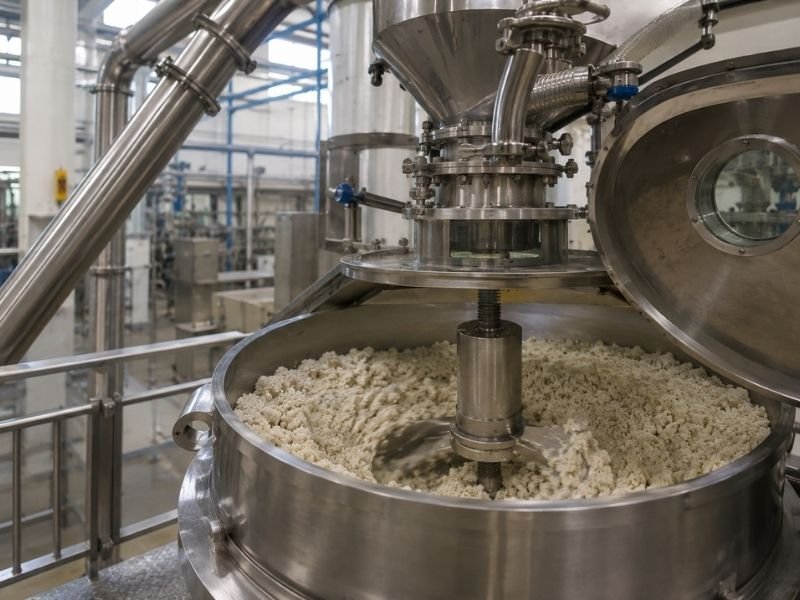
Granulation Dust Collection — Quick Guide
Jump directly to wet vs dry granulation, drying, post-granulation dust, collector selection, or the information needed for system sizing.
Why Granulation Dust Collection Depends on the Process Stage
Granulation is different from simple powder transfer because the material can move through dry powder, wetted mass, partially dried granules, and fully dried product during the same process. Dust generation and filtration requirements can therefore change significantly from charging to drying, sizing, discharge, and downstream transfer.
The Dust Problem Often Appears Before and After Granulation—Not at the Same Intensity Throughout
Dry ingredient charging can release fine airborne powder. Once binder or moisture is introduced, airborne dust may decrease while sticking and deposit formation become more important. After drying and sizing, the product can again generate fine dust during screening, milling, conveying, and discharge.
Dry Ingredient Charging
Powder addition to a granulator or pre-mixer can create short, concentrated dust releases at charging openings and transfer points.
Wet Mass Formation
Added liquid can reduce airborne dust but may increase adhesion, deposits, and cleaning demands around vents and equipment surfaces.
Drying
Airflow becomes part of the process, especially in fluid-bed drying, where product retention and fine-particle carryover must be controlled together.
Sizing & Transfer
Dry granules may generate fines again during screening, milling, conveying, discharge, and transfer to the next process.
Design around the material state at each stage.
The most appropriate extraction point, filter media, airflow, cleaning strategy, and collected-dust handling may differ between dry charging, wet granulation, drying, and post-drying sizing. Process information is more useful than a generic “granulation CFM” value.
Wet and Dry Granulation Create Different Dust Collection Conditions
Granulation technology matters. Wet granulation introduces binder or liquid, while dry granulation compacts or densifies powder without adding liquid. These process differences change where dust is generated, how easily material sticks, and which parts of the line need extraction or filtered venting.
More Moisture, Less Airborne Dust During the Wet Stage
Powder Remains Dry Through Compaction and Sizing
Dust Control Around Granule Drying Requires Process-Air Awareness
Drying equipment can move much more air than a simple local extraction point. In fluid-bed systems, process air passes directly through the product bed, so fine-particle carryover, product retention, exhaust filtration, temperature, and moisture are closely connected.
The Dryer Exhaust Is Part of the Process, Not Just a Dust Hood
A fluid-bed dryer or similar process may already include internal filters, product-retention systems, or dedicated exhaust treatment. An external dust collector should only be integrated after understanding the OEM air path, temperature, moisture, cleaning cycle, and the amount of product that can reach the exhaust.
Fine-Particle Carryover
Air moving through the product bed can entrain fines, especially during early or late drying stages.
Temperature
Dryer exhaust temperature can affect filter-media selection and downstream condensation risk.
Moisture
High humidity or wet carryover can increase adhesion and filter plugging if the filtration stage is not appropriate.
Product Recovery
Collected fines may be valuable product, waste, or material that requires controlled handling depending on the process.
Screening, Milling and Transfer Can Reintroduce Fine Dust After Drying
Once granules are dry, the process may again behave like a dry powder handling system. Screening, de-lumping, milling, conveying, discharge, and packaging can generate fines even if the wet granulation stage itself produced little airborne dust.
Dryer Discharge
Dry granules leave the dryer and enter a receiver, bin, conveyor, or transfer container.
Screening / Sizing
Screens and classifiers can separate fines and oversize material while creating new dust-release points.
Milling / De-Lumping
Oversize granules may be reduced to the target size, creating additional fine particles.
Downstream Transfer
Finished granules may continue to blending, tablet pressing, capsule filling, packaging, or storage.
Control Drop Height
Long free-fall distances can increase dust dispersion and air entrainment as dry granules move into downstream receivers.
Vent the Receiver
Bins and containers need a controlled route for displaced air when product enters rapidly.
Avoid Unnecessary Product Loss
Extraction should control fines without pulling excessive saleable granules into the dust collection system.
Granulation Can Create Filter Problems That Dry Powder Systems Do Not
Wet carryover, changing moisture content, fine dried product, and temperature shifts can create difficult filtration conditions. These issues should be considered before connecting granulation or drying equipment to a conventional dust collector.
Wet or Sticky Carryover
Moist material reaching the filter can form deposits that pulse cleaning may not remove effectively.
Condensation
Warm humid exhaust cooling in ducts or filters can create condensation and increase dust adhesion.
Fine Dried Product
After drying and sizing, fines may load filters quickly or migrate through transfer points that were relatively clean during the wet stage.
Product Build-Up
Cohesive granules or fines may bridge in hoppers, stick to duct surfaces, or accumulate in poorly drained parts of the system.
Product Loss
Excessive extraction can carry useful fines or small granules into the collector instead of the intended product stream.
Combustible-Dust Risk
Some dry pharmaceutical, food, chemical, or other organic powders may be combustible, but the risk should be evaluated from actual material data rather than assumed from the process name.
Selecting Dust Collection Equipment for Granulation Processes
Collector selection should reflect whether the connection handles dry charging dust, dryer exhaust, fine dried granules, post-granulation milling, or general transfer dust. These are different duties and should not automatically share the same filtration approach.
Cartridge Dust Collector
Cartridge filtration can be evaluated for dry ingredient charging, post-drying fines, screening, or transfer dust when the material is compatible with pleated media and moisture is controlled.
Dry fines · Moderate loading · Compact footprint · Post-drying or transfer dust
Baghouse Dust Collector
A baghouse may be suitable for higher dry dust loading, larger airflow, continuous downstream handling, or applications where a different filter-media format provides better dust-holding capacity.
Higher dry loading · Large airflow · Centralized collection · Special media requirements
Process-Specific Final Filtration
Fluid-bed dryer and similar process exhausts should be reviewed as part of the OEM air system. Temperature, moisture, internal product-retention filters, exhaust volume, and hygiene requirements can make a standard dust collector inappropriate without further engineering.
High process airflow · Warm humid exhaust · Internal filters · Product recovery · Hygiene constraints
Do not connect wet carryover to a dry dust collector by default.
If the air stream can contain sticky wet product or condensation, the filtration approach should be reviewed specifically for that condition. In many projects, dry charging and post-drying dust are more suitable targets for conventional dust collection than the wet granulation stage itself.
Information Needed to Design a Granulation Dust Collection System
You do not need to calculate airflow before contacting us. The most useful starting point is the process sequence: wet or dry granulation, equipment type, charging method, dryer type, final particle size, material properties, post-granulation milling or screening, and the actual points where dust escapes.
Granulation Equipment
Equipment data identifies vents, openings, product-retention features, discharge points, and available extraction connections.
Material & Particle Data
Material condition determines dustiness, adhesion, filtration, cleaning, and product-recovery behavior.
Batch & Drying Conditions
Batch rate, charging time, dryer airflow, temperature, and humidity can strongly affect the duty of the air system.
Transfer & Site Information
Downstream receivers, ducts, installation space, utilities, and cleaning requirements shape the final arrangement.
Related Granulation Dust Collection Guides & Solutions
Granulation is used in pharmaceutical, food, chemical, fertilizer, mineral, and other powder-processing industries. The process sequence determines which related applications and dust collection technologies are most relevant.