
Packaging Dust Collection — Quick Guide
Jump directly to filling, displaced air, sealing, product loss, collector selection, or the information needed for system sizing.
Why Powder Packaging Needs a Different Dust Control Strategy
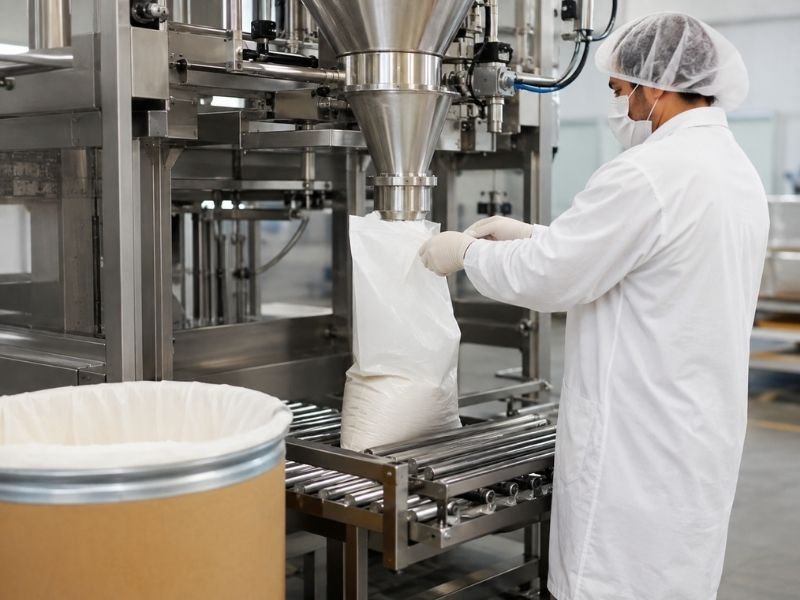
Packaging dust is usually generated when finished powder or granules move from a process hopper into bags, drums, boxes, bottles, sacks, or other containers. The dust collector must control airborne fines and displaced air without pulling excessive saleable product away from the filling point.
Every Container Must Release Air as Product Fills the Available Volume
As powder enters a bag, drum, bin, or container, air is pushed out. If this displaced air carries fine particles, dust can escape around the filling spout, container opening, clamp, or operator area. Effective packaging dust collection therefore focuses on controlled venting and close capture at the fill point.
Filling Point Dust
Dust can escape around the product stream, filling spout, bag neck, drum opening, or container mouth.
Displaced Air
Fast filling can push a significant amount of air out of the container in a short period.
Final Product Loss
Excessive suction can remove useful product along with dust and increase filter loading.
Frequent Operator Interaction
Bag placement, weighing, sealing, cleaning, and rejected-package handling can release residual dust close to workers.
Capture dust before it spreads beyond the packaging station.
A well-designed fill head, enclosure, vent connection, or close-capture hood can reduce the airflow needed for effective dust control. This often improves both capture and product yield compared with relying on large amounts of general room extraction.
Dust Control for Bags, Drums, Containers and Bulk Packaging
The packaging method changes the capture strategy. Open bags, valve bags, drums, rigid containers, FIBCs, and automated filling machines all create different openings, fill rates, and displaced-air paths.
Open-Mouth Bag Filling
Powder enters an open bag while air escapes around the fill spout and bag neck.
Valve Bag Filling
A smaller filling opening can improve containment, but fine powder may still escape at the valve or machine interface.
Drum / Rigid Container Filling
A rigid receiver cannot collapse as it fills, so displaced air must leave the container as product volume increases.
Bulk Bag / FIBC Filling
Large fill volumes and high throughput can create substantial displaced air during the filling cycle.
The best capture point is usually built around the fill head.
Keeping the opening small and the extraction close to the escaping air path can reduce dust spread without applying excessive suction to the product stream.
Control the Air Leaving the Package as Product Enters
Packaging dust control is often an air-management problem as much as a dust problem. The faster the product enters the package, the faster air must leave. If the escaping air carries fines, the vent or capture point should intercept that air before it reaches the room.
Give Displaced Air a Controlled Route
A bag or container that fills rapidly can act like a small vessel venting into the workplace. The dust collection system should relieve this air without creating unnecessary negative pressure inside the package or pulling product directly into the extraction connection.
More airflow is not automatically better. Good geometry and close capture often matter more than simply increasing fan volume.
Fill Rate
Higher kg/min or bags/hour can create stronger short-duration airflow at the package opening.
Container Volume
Large drums, bins, and FIBCs can displace more air during each fill cycle.
Product Dustiness
Fine, low-density powders can be carried out of the package more easily than coarse granules.
Spout / Enclosure Design
A well-sealed fill head can reduce the amount of room air that must be captured.
Dust Can Continue During Weighing, Sealing, Cleaning and Package Handling
The visible dust cloud often occurs during filling, but residual powder can remain on the bag neck, container rim, machine surface, weighing platform, or conveyor. Final handling should keep that material from becoming airborne again.
Final Weighing
Top-off filling and weight correction can create repeated short dust releases around the filling head.
Bag / Container Closing
Powder on the neck or rim can be disturbed during folding, heat sealing, stitching, capping, or lid installation.
Surface Cleaning
Cleaning packages and machinery can re-suspend deposited powder if not controlled.
Conveying & Palletizing
Poorly sealed packages or powder-coated exteriors can spread dust downstream.
Keep the Package Exterior Clean
Dust deposited on bag or drum surfaces can migrate beyond the packaging area even after filling is complete.
Avoid Uncontrolled Air-Blow Cleaning
Compressed air used for housekeeping can spread settled dust back into the workplace.
Design for Changeover
Packaging lines serving multiple products may need cleaning access and product-separation practices between batches.
Control Packaging Dust Without Pulling Valuable Product Into the Collector
Packaging often handles finished product, so dust collection should remove airborne fines without unnecessarily capturing large amounts of saleable powder or granules. Capture geometry, airflow, fill rate, and filter loading should be balanced together.
Excessive Extraction
Too much suction close to the fill stream can pull useful product away from the package.
Poor Fill-Head Sealing
A large open gap can require more room air capture and make dust control less efficient.
Filter Loading
Heavy product carryover can increase differential pressure and reduce available airflow at the filling point.
Recovered Dust Handling
Captured product may be reusable, downgraded, contaminated, or waste depending on the process and hygiene requirements.
Selecting a Dust Collector for Powder Packaging Lines
Collector selection depends on product fineness, fill rate, number of packaging stations, simultaneous operation, dust loading, hygiene requirements, available space, and whether the packaging line should remain independent from the wider plant dust collection system.
Cartridge Dust Collector
Cartridge filtration can suit dry, fine packaging dust with moderate loading and multiple localized fill points when the product is compatible with pleated media.
Dry fine powder · Moderate loading · Compact footprint · Several local packaging points
Baghouse Dust Collector
A baghouse may be appropriate for higher dust loading, larger airflow, high-throughput packaging, or centralized systems serving several filling machines or material-handling points.
Higher loading · Large airflow · Continuous operation · Centralized packaging area
Portable or Compact Dust Collector
For a single bagging point, drum filling station, pilot line, or small batch operation, a compact local collector can reduce duct length and keep the packaging station independent.
Single station · Small batch · Flexible layout · Short duct run · Independent extraction
Final product properties still control the filtration choice.
Very fine, sticky, hygroscopic, abrasive, potent, or combustible powders may require different filter media, containment, cleaning, dust-discharge, or protection measures. The packaging machine alone does not determine the collector.
Information Needed to Design a Packaging Dust Collection System
You do not need to know the final airflow before contacting us. Packaging machine details, product properties, fill rate, package type, number of filling points, simultaneous operation, existing vent connections, and site layout are usually enough to begin a preliminary engineering review.
Packaging Equipment
Machine data helps identify the filling head, available vent connections, package opening, enclosure, and extraction interfaces.
Product & Dust Data
Product properties influence dustiness, filter selection, carryover, product recovery, cleaning, and hazard evaluation.
Packaging Rate & Container
Fill rate and package geometry directly affect displaced air and the short-term airflow peak at the filling point.
Site & Downstream Handling
Duct routing, space, utilities, sealing, conveying, cleaning, and palletizing conditions influence the final system arrangement.
Related Packaging Dust Collection Guides & Solutions
Powder packaging is used across pharmaceutical, food, chemical, mineral, pigment, battery-material, plastic, feed, and other processing industries. Related upstream processes often influence the final product condition entering the packaging line.