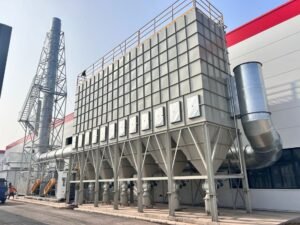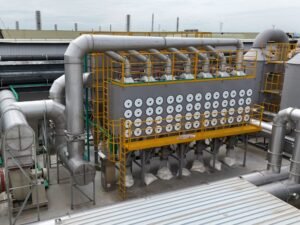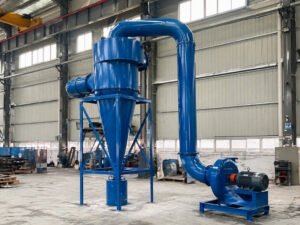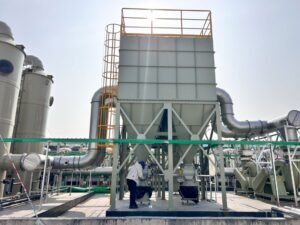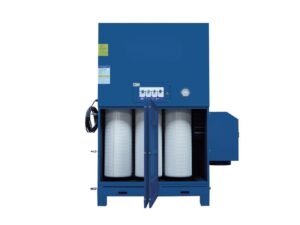
A welding fume extractor usually refers to a local extraction unit or capture device used near the welding point. A welding dust collector usually refers to the filtration equipment or full dust collection system that captures welding fume and metal particulate through filters, fan airflow, ductwork, and dust handling.
In real industrial buying, the two terms often overlap. Many buyers use “welding fume extractor” when they need a portable local unit, and use “welding dust collector” when they need a larger cartridge collector or central ducted system. The better question is not which term is correct. The better question is what system scope your welding area actually needs.
If you are planning a full welding fume extraction system, the right selection depends on welding process, station count, capture method, airflow, duct route, filter maintenance, and whether sparks or mixed dust need review.
Quick Answer: What Is the Difference?
| Term | What Buyers Usually Mean | Typical Fit |
|---|---|---|
| Welding fume extractor | A local or portable unit used to capture welding smoke and fine fume close to one welding point. | Single station, flexible welding work, temporary repair, maintenance welding, local suction arm. |
| Welding dust collector | The dust collection equipment or system used to filter welding fume, fine metal dust, and captured particulate. | Multiple fixed stations, cartridge collector, central ducted system, larger filtration scope. |
| Welding fume extraction system | The complete solution including capture device, airflow, fan, filters, ducts, controls, and installation layout. | Project-level term for both local and central welding fume control. |
For one flexible welding station, a local fume extractor or portable unit may be enough. For several fixed welding stations, a welding dust collector with planned capture points, ductwork, fan, and cartridge filtration may be more practical.
Why the Terms Are Confusing
The confusion comes from the way welding fume behaves and the way equipment is named.
Welding fume is fine airborne particulate. It looks like smoke, rises with hot air, and can spread quickly if it is not captured close to the source. Because of this, many buyers search for a fume extractor, smoke extractor, or welding fume extractor.
At the same time, industrial suppliers often use the term dust collector because the equipment filters particulate from the air stream. A cartridge dust collector, portable dust collector, or central dust collection system can all be used in welding applications when the process conditions fit.
So the words are not completely separate. A welding fume extractor may include filter cartridges. A welding dust collector may be used for welding fume. The real difference is usually system size, capture method, and quotation scope.
What Is a Welding Fume Extractor?
A welding fume extractor is usually a local extraction device or compact unit designed to capture welding fumes near the weld point.
Typical features may include:
- suction arm or hose
- local hood or nozzle
- fan
- filter cartridge or filter stage
- dust drawer or collection container
- mobile base or compact frame
- local control switch
For many buyers, “welding fume extractor” means a portable unit placed near one workstation. In Novazure’s product structure, this need is usually closest to a portable dust collector when the work area is flexible or the buyer needs local capture without central ductwork.
When a Welding Fume Extractor Makes Sense
A local extractor is often a practical starting point when:
- there is one welding station
- the welding point changes location
- the work is intermittent or temporary
- the workshop cannot install fixed ductwork yet
- operators need a movable suction arm
- the buyer wants a simpler local quotation scope
The main limitation is coverage. A local extractor must be placed close enough to the fume source. If the suction arm is too far from the weld, fumes may rise and spread before they are captured.
What Is a Welding Dust Collector?
A welding dust collector is usually the filtration equipment or system used to collect welding fume and fine metal particulate from one or more capture points.
For many fine dry welding fume projects, the equipment path may include a cartridge dust collector, fan, control cabinet, ductwork, and capture devices such as arms, hoods, booths, or table connections.
Typical system components may include:
- cartridge collector body
- filter cartridges
- pulse cleaning system
- fan and motor
- control cabinet
- suction arms, hoods, booths, or enclosure connections
- main duct and branch ducts
- dust drawer, bin, or hopper
- maintenance access around filters and dust discharge
When a Welding Dust Collector Makes Sense
A welding dust collector is often more suitable when:
- there are multiple fixed welding stations
- several capture points need one shared filtration system
- the buyer wants centralized maintenance
- the workshop layout can support ductwork
- airflow and branch layout need to be planned
- the fume load or working hours are too high for small local units
A dust collector is not only a bigger fume extractor. It is usually part of a system that must be sized around airflow, duct resistance, filter area, and capture-point layout.
Compare by Buyer Situation
| Buyer Situation | Better Search / Inquiry Term | Why |
|---|---|---|
| One manual welding table | Welding fume extractor | The buyer likely needs a local unit or suction arm solution. |
| Welding point changes often | Portable welding fume extractor | Mobility and local capture matter more than central ductwork. |
| Several fixed welding booths | Welding dust collector | A central collector and ducted system may be more practical. |
| Robotic or repeated welding cell | Welding fume extraction system | The project needs capture, airflow, collector, and layout review together. |
| Buyer already has ducts or hoods | Welding dust collector | The supplier must size collector, fan, filters, and pressure. |
| Buyer is not sure what system is needed | Welding fume extraction system | This allows the supplier to review the whole project instead of one product name. |
If you are unsure, describe the working condition instead of relying only on the equipment name.
Capture Method Matters More Than the Name
Whether you call it a fume extractor or a dust collector, the system must capture fume near the source.
Common capture methods include:
| Capture Method | Often Used With | Selection Notes |
|---|---|---|
| Flexible suction arm | Portable extractor or central duct branch | Good for manual welding if the arm can stay close to the weld. |
| Fixed hood | Central dust collector | Works better when welding position is repeated and predictable. |
| Booth or enclosure | Central system | Helps contain fume before it spreads into the workshop. |
| Downdraft table | Local or central system | Useful for suitable small parts when the work happens on the table surface. |
| Machine or cell connection | Central collector | Needs clear connection point, airflow estimate, and layout review. |
Poor capture cannot be solved by the equipment name. A powerful collector connected to a poorly positioned hood may still fail to capture fumes at the source. A smaller local extractor placed correctly can be more useful than a larger unit placed too far away.
Airflow and Filter Size Still Decide the Equipment
The final equipment size depends on airflow and filter loading, not only on whether the buyer says extractor or dust collector.
For a local fume extractor, Novazure needs to know:
- welding process
- local capture arm or hood type
- distance from the welding point
- working hours
- fume level
- whether the unit will serve one station or move between areas
For a central welding dust collector, Novazure also needs:
- number of welding stations
- number of stations operating at the same time
- capture method at each station
- duct distance and branch layout
- fan position
- filter area and maintenance access
- spark or mixed dust condition
If airflow is not confirmed, the published guide on how to calculate airflow for a dust collection system can help with early planning. Final airflow should still be checked with the actual welding layout.
Filter and Maintenance Differences
Local extractors and central dust collectors can both use filters, but the maintenance scope is different.
| Item | Local Welding Fume Extractor | Central Welding Dust Collector |
|---|---|---|
| Filter quantity | Usually smaller and local to the unit | Usually larger total filter area |
| Maintenance location | Near the workstation | Centralized collector location |
| Dust handling | Small drawer or container | Drawer, bin, hopper, or other discharge method |
| Expansion | Limited by unit capacity | Can be planned for several capture points if reviewed |
| Downtime impact | Usually affects one station | May affect several stations if one central system stops |
This is why buyers should not compare only the equipment label. Compare filter area, working hours, dust load, access space, and replacement requirements.
Ductwork and Installation Scope
A welding fume extractor often has little or no fixed ductwork. It may use a suction arm, hose, or short connection near the work area.
A welding dust collector may require:
- main duct
- branch ducts
- elbows and dampers
- support structures
- collector location planning
- fan position
- maintenance clearance
- possible future expansion review
Long duct routes and multiple branches can affect fan pressure, equipment size, and installation space. If the buyer already has a workshop layout, sending a simple sketch can help the supplier understand whether the project is a local extraction unit or a central dust collection system.
Which Term Should You Use When Requesting a Quote?
Use welding fume extractor if your project is mainly local:
- one welding station
- movable suction arm
- flexible work area
- temporary repair or maintenance welding
- compact local unit
- little or no ductwork
Use welding dust collector if your project has a larger system scope:
- multiple fixed welding stations
- central filtration equipment
- duct branches
- shared fan and controls
- cartridge collector selection
- larger filter and maintenance planning
Use welding fume extraction system if you want the supplier to review the whole solution, including capture method, airflow, collector type, ductwork, filters, fan, controls, and layout.
Information to Prepare Before Contacting Novazure
To avoid confusion, send the working condition rather than only a product name.
Useful information includes:
- welding process
- base material and coating condition
- number of welding stations
- fixed or flexible welding points
- capture method, such as arm, hood, booth, or table
- airflow estimate, if available
- duct distance or layout sketch
- working hours per day
- whether sparks, cutting, grinding, or mixed dust are present
- available installation space
- photos or videos of the welding area
If you are unsure whether you need a fume extractor or a welding dust collector, Novazure can review these details and recommend the more practical system direction.
FAQ
Not always. The terms can overlap, but a welding fume extractor usually means a local or portable capture unit. A welding dust collector usually means filtration equipment or a larger system that may serve one or more welding points.
Welding fume is fine airborne particulate generated by welding. In industrial dust collection, it is often handled by dust collector equipment when the fume is suitable for dry filtration and the system is designed correctly.
Ask for a welding fume extractor if you need local capture for one flexible station. Ask for a welding dust collector if you need filtration equipment, ductwork, or a central system for multiple stations. If you are unsure, ask for a welding fume extraction system review.
In some single-station or flexible welding applications, a portable dust collector with suitable local capture can be used as a welding fume extractor. The final choice depends on fume load, airflow, filter configuration, working hours, and spark or mixed dust review.
A cartridge dust collector is usually more suitable when several fixed welding stations need centralized filtration, planned ductwork, and larger filter area. A portable extractor is usually more suitable for one flexible welding point.
Conclusion
The difference between a welding fume extractor and a welding dust collector is mainly about system scope. A fume extractor usually describes local capture near one welding point. A dust collector usually describes the filtration equipment or central system used to handle captured welding fume and fine metal particulate.
For buyers, the safest way to avoid confusion is to describe the welding process, station count, capture method, airflow estimate, workshop layout, duct distance, working hours, and spark or mixed dust condition.
You can contact Novazure with those details. Novazure can help review whether a local welding fume extractor, portable dust collector, central cartridge dust collector, or another welding fume extraction configuration is more suitable for your workshop.